
How SEO-Friendly Web Development Increases Business Growth

Introduction: Your Website Is Your Most Important Business Growth Asset
In 2026, your website is not a digital brochure. It is the primary engine through which your business attracts visitors, establishes credibility, generates leads, and converts prospects into paying customers, operating 24 hours a day, in every market you serve, without requiring a single sales call to initiate the relationship. And yet, the vast majority of business websites are built with an almost complete disregard for the mechanics that determine whether that engine runs efficiently or sits idle.
The stakes are high, and the evidence is unambiguous. 68% of all online experiences begin with a search engine. Organic search drives over 1,000% more traffic than social media. 53.3% of all website traffic comes from organic search (BrightEdge). And 75% of users never scroll past the first page of Google (EwaanTech, 2026). If your website is not built to rank, you are invisible to the majority of your potential customers at the exact moment they are looking for what you offer.
The solution is not more advertising spend. It is SEO-friendly website development, the discipline of building websites where every structural, technical, and design decision is made with organic search visibility and user experience in mind simultaneously. An SEO-driven web development approach is not a post-launch marketing layer bolted onto an already-built site. It is an architectural philosophy that shapes every decision from the first line of code.
Pearl Organisation is a full-service custom website development and digital transformation company helping businesses across India and globally build websites that are not just visually compelling but technically engineered to rank, convert, and grow. This guide explains exactly what that means, and why it matters for your bottom line.
1. What Is SEO-Friendly Website Development?
Definition and Scope
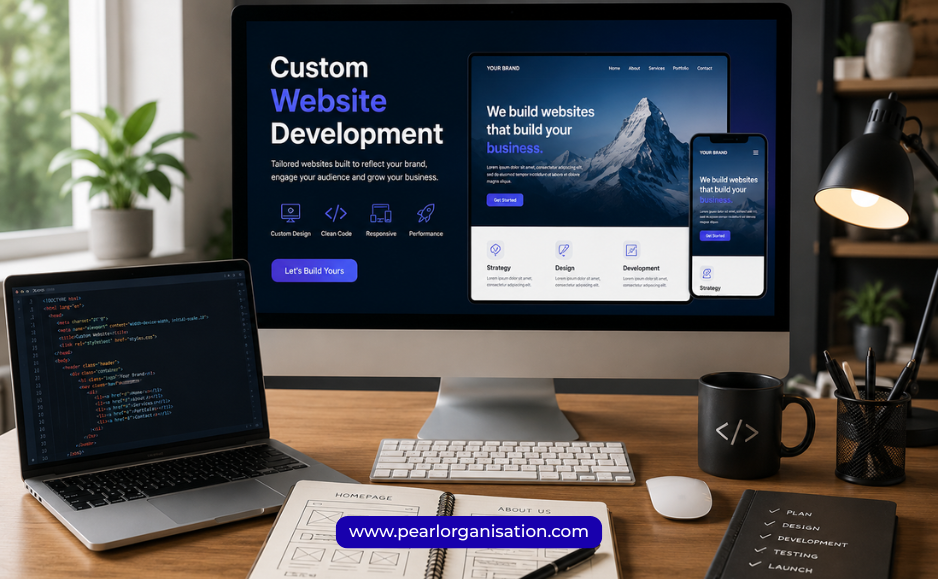
SEO-friendly website development is the practice of building websites where the technical architecture, code quality, site structure, page speed, content organisation, and user experience are all designed to support strong organic search engine performance, from the very first day of development, not as an afterthought after the site launches.
The distinction between a standard website and an SEO-friendly website is not visible to the casual observer. Both may look professional and function adequately. But under the hood, the differences are significant: clean semantic HTML that search engines parse efficiently versus bloated, tag-heavy markup; fast-loading pages optimised for Core Web Vitals versus pages that fail performance benchmarks; logical URL structures and internal linking versus arbitrary navigation hierarchies; schema markup that enables rich results versus no structured data at all; mobile-first responsive design versus desktop-centric layouts that perform poorly on mobile devices.
These are not cosmetic differences. Pages ranking in position #1 have approximately 10% higher Core Web Vitals pass rates compared to pages in position #9 (WebsiteSpeedy, 2026). Core Web Vitals now affect 40% of search visibility. And websites with excellent technical SEO foundations consistently outperform competitors with comparable content quality but inferior technical implementation, because when content quality is similar, technical performance becomes the deciding ranking factor.
SEO-Friendly Website Design vs. SEO-Friendly Website Development
These terms are related but distinct, and understanding the difference is important for making informed investment decisions:
Dimension | SEO-Friendly Website Design | SEO-Friendly Website Development |
Primary focus | Visual layout, UX, navigation, information architecture, content structure | Code quality, page speed, crawlability, structured data, technical performance |
Who owns it | Designer / UX team | Development team / technical SEO specialist |
Impact area | User engagement, bounce rate, on-page time, visual trust signals | Crawl efficiency, indexation, Core Web Vitals, schema markup, render speed |
When it matters | Shapes how users experience and navigate the site | Determines whether search engines can find, understand, and rank the site |
Common mistakes | Pretty design that ignores information hierarchy and content readability | Functional code that ignores performance, semantic structure, and crawlability |
Shared goal | Both must work together to produce an SEO optimized website that ranks AND converts | Both must work together to produce an SEO optimized website that ranks AND converts |
2. How SEO-Friendly Web Development Drives Measurable Business Growth
The connection between SEO-friendly website development and business growth operates through five interconnected growth mechanisms, each independently valuable, and exponentially more powerful when they operate together:
01 Organic Search Visibility: The Traffic Engine That Never Turns Off
Every page of your website that ranks on the first page of Google for a relevant search query is a 24/7 customer acquisition asset that generates traffic without per-click costs. Unlike paid advertising, which stops the moment budget is withdrawn, organic search rankings built on solid SEO-friendly website development are durable, compounding assets. A well-optimised website can continue generating traffic and leads for months or even years without additional media investment. The financial case is compelling. SEO delivers 748% median ROI, returning $7.48 for every dollar invested (AllOutSEO, 2025–2026). Organic search drives 1,000%+ more traffic than social media. And SEO leads convert at 14.6%, nearly nine times the 1.7% conversion rate of outbound leads. For any business serious about sustainable growth, organic search is the highest-leverage digital channel available, and an SEO optimized website is the asset that captures it.
02 User Experience and Conversion: Turning Visitors Into Revenue
SEO-friendly website design and conversion optimisation are not separate disciplines, they are the same discipline viewed from different angles. Google's Core Web Vitals, which measure loading speed (LCP), interactivity (INP), and visual stability (CLS), are ranking factors specifically because they quantify user experience. A website that loads in under 2.5 seconds, responds instantly to user interactions, and presents stable, predictable layouts creates the conditions for both strong rankings and high conversion rates simultaneously. The business impact of user experience quality is direct and measurable. Brands with user-friendly websites reduce customer service costs by up to 50% (EwaanTech, 2026). 62% of businesses saw increased sales after making their websites mobile-friendly. And 64% of people expect to find contact information on a business website, if it's missing or hard to find, they leave. Every user experience improvement that raises your Core Web Vitals scores improves both your search rankings and your conversion rates in the same action.
03 Mobile-First Performance: Capturing 60% of All Search Traffic
Mobile devices now account for approximately 60% of all global internet searches (Queens Digital Agency, 2026). Google operates on a mobile-first indexing model, meaning it evaluates and ranks your website based on its mobile version, not its desktop version. A website that performs beautifully on desktop but loads slowly or renders poorly on mobile is being evaluated and ranked on its worst performance, regardless of how strong its desktop experience is. For businesses in India, where smartphone penetration vastly exceeds desktop ownership across urban and rural markets alike, mobile-first performance is not optional. It is the baseline. SEO-driven web development treats mobile performance as the primary design and engineering constraint, with desktop experience as a secondary optimisation. This approach directly impacts search rankings, bounce rates, time on site, and ultimately the lead generation and revenue outcomes that website performance determines.
04 Local Search Dominance: Winning High-Intent Nearby Queries
Local search is one of the highest-converting traffic sources available to any business serving a geographic market. 78% of mobile local searches lead to an offline purchase. And organic search, including local SEO, drives 53.3% of all website traffic, making it the dominant source of local customer acquisition for businesses with physical presence or geographic service areas. SEO-friendly website development for local visibility requires specific technical implementations: structured data markup for local business schema, optimised Google Business Profile integration, location-specific page structure, consistent NAP (Name, Address, Phone) signals across the site, and technical performance sufficient to rank in the Local Pack, the prominent map-and-listing results that appear for location-intent queries. Even startups with no domain authority can appear alongside major brands in local search results when their website is correctly structured for local signals.
05 Brand Credibility and Trust: Search Ranking as Social Proof
A consistent first-page presence on Google for searches related to your business category creates a trust halo that no paid advertisement can replicate. Consumers interpret high organic rankings as an endorsement of credibility, a signal that Google, the world's most trusted information authority, has validated your relevance and authority on the topic. This trust effect compounds over time as branded search volume grows, as users encounter your content across multiple queries, and as your website becomes associated with genuine expertise in your domain. For businesses competing against established incumbents, SEO-friendly website development is the great equaliser. Organic search visibility is not for sale by seat or by brand reputation, it is earned through technical excellence, content quality, and user experience. A smaller business with a technically superior, better-structured, faster-loading website consistently outranks larger competitors with poor technical foundations.
3. Technical SEO Implementation: The Non-Negotiable Foundation

Technical SEO implementation is the layer of SEO-friendly website development that determines whether search engines can find, crawl, understand, and rank your content — regardless of how well-written that content is. A fundamental truth in technical SEO: Google cannot rank a page it cannot crawl and index (Techlooker, 2026). No amount of content quality or backlink strength compensates for technical barriers that prevent search engines from accessing your pages.
Core Web Vitals: The Performance Ranking Factors
Google's Core Web Vitals are the three primary performance metrics that quantify real user experience and function as direct ranking signals. In 2026, they are the most explicitly defined technical SEO ranking requirements:
Core Web Vital | What It Measures | Target Score | Primary Cause of Failure | SEO Impact |
Largest Contentful Paint (LCP) | How quickly the largest visible element (image or text block) loads for real users | Under 2.5 seconds | Unoptimised images, render-blocking resources, slow server response | Direct ranking factor; pages failing LCP concede ranking position to passing competitors |
Interaction to Next Paint (INP) | How quickly the page responds to user interactions throughout the entire session — taps, clicks, keyboard input | Under 200 milliseconds | Heavy JavaScript execution, unoptimised third-party scripts, synchronous JS | Most commonly failed metric in 2026; requires full-session JS optimisation, not just initial load |
Cumulative Layout Shift (CLS) | Visual stability — how much the page layout shifts unexpectedly as content loads, causing users to misclick | Under 0.1 | Images without dimensions, dynamically injected content, web fonts without fallback | Poor CLS directly causes user frustration and abandoned sessions |
The business case for Core Web Vitals optimisation is direct. Core Web Vitals now affect 40% of search visibility, with pages in position #1 consistently showing 10% higher Core Web Vitals pass rates than those in position #9. One documented case study showed a 207% improvement in mobile PageSpeed score following Core Web Vitals optimisation, directly reducing bounce rates and improving conversion outcomes (SEO Discovery, 2026).
The Complete Technical SEO Implementation Checklist
Beyond Core Web Vitals, a fully SEO-friendly website development project requires implementation across the following technical domains:
Technical SEO Area | Key Implementation Requirements | Business Impact |
Crawlability & Indexation | XML sitemap; clean robots.txt; canonical tags; proper HTTP status codes (all key pages returning 200); no orphaned pages; logical internal linking | Ensures Google can discover and index every page that should rank; non-200 status pages may be excluded from Google's rendering queue entirely (Google, Dec 2025) |
Site Architecture | Logical URL structure (keyword-rich, hierarchical); breadcrumb navigation; flat site structure (maximum 3 clicks from homepage to any page); consistent navigation | Makes both users and search engines efficient at finding content; reduces crawl budget waste on large sites |
Schema Markup (Structured Data) | Organisation schema; LocalBusiness; Product; FAQ; Article; BreadcrumbList; Speakable for AI Overview citation | Enables rich results (review stars, FAQ dropdowns, knowledge panels); dramatically increases click-through rates and AI search visibility |
Mobile-First Design | Responsive layout at all breakpoints; tap targets minimum 48px; no horizontal scrolling; mobile Core Web Vitals passing on real devices | Google indexes mobile version first; mobile failures directly impact rankings across all devices |
HTTPS & Security | SSL certificate; HTTPS on all pages; HSTS implementation; no mixed content errors | Google treats HTTPS as a ranking signal; insecure sites show browser warnings that destroy user trust and conversion rates |
Image Optimisation | WebP format; responsive srcset; lazy loading; explicit width/height attributes to prevent CLS; descriptive alt text | Images are the primary cause of LCP failures; WebP reduces file size 25–35% vs JPEG with equivalent quality |
JavaScript Optimisation | Deferred non-critical JS; async attributes; code splitting; elimination of render-blocking scripts; minimal third-party script load | Heavy JS is the primary cause of INP failures and slow LCP; clean JS architecture is a development requirement, not an afterthought |
Meta & On-Page Structure | Unique title tags (50–60 characters); meta descriptions (150–160 characters); single H1 per page; logical H2/H3 hierarchy; keyword-natural content | Title tags and headings are the primary signals search engines use to understand page topic and relevance |
Page Speed Infrastructure | Content Delivery Network (CDN); server-side caching; browser caching; GZIP/Brotli compression; optimised hosting environment | Server response time (TTFB) directly impacts LCP; CDN reduces latency for geographically distributed audiences |
4. Website Optimisation for Search Engines: On-Page and Content Architecture

How Content Architecture Determines Organic Performance
Website optimisation for search engines is not only a technical discipline, it is an information architecture challenge. How your website organises, structures, and connects content determines how effectively search engines understand what your site is about, which topics you have authority on, and which pages should rank for which queries.
In 2026, Google's ranking algorithms evaluate topical authority, the depth and comprehensiveness of a website's coverage of a specific subject area,as a primary signal of relevance and credibility. A website with a logical, hierarchical content architecture that comprehensively covers its core topics builds topical authority systematically, while a collection of disconnected pages targeting individual keywords builds none.
Pillar-Cluster Content Architecture
The pillar-cluster model is the most effective content architecture for building topical authority and sustainable organic rankings:
Pillar pages; comprehensive, authoritative guides covering a broad topic in depth (for example: a complete guide to custom website development). These pages target high-volume, competitive keywords and serve as the authoritative hub for a topic area
Cluster pages: detailed, specific articles covering individual subtopics related to the pillar (for example: technical SEO implementation, Core Web Vitals optimisation, mobile-first design for SEO). These pages target longer-tail, lower-competition keywords with higher conversion intent
Internal linking: bidirectional links between pillar and cluster pages pass authority and help search engines understand the relationship between content. Strong internal linking architecture is consistently associated with improved rankings across all pages in the cluster
On-Page Optimisation Elements for an SEO Optimized Website
Title tags: the single most important on-page SEO element. Each page needs a unique, descriptive title (50–60 characters) that includes the target keyword naturally and creates genuine click-through appeal in search results
Meta descriptions; not a direct ranking factor but a critical CTR driver. Compelling meta descriptions (150–160 characters) that clearly communicate the page's value significantly improve organic click-through rates, which feeds positive engagement signals back to Google
Header hierarchy; a clear H1 (one per page, containing the primary keyword), logical H2 and H3 subheadings that structure content for both users and search engines, and natural keyword inclusion within headings without forcing
Image SEO; descriptive, keyword-natural file names; accurate alt text for every meaningful image; WebP format; explicit dimensions to prevent CLS; lazy loading for below-fold images
URL structure: short, descriptive, keyword-containing URLs with hyphens rather than underscores; no dynamic parameters for indexable pages; consistent canonicalisation
E-E-A-T signals: author attribution with credentials, About Us pages that establish business history and expertise, clear editorial standards, and external citations of authoritative sources. Google's E-E-A-T (Experience, Expertise, Authoritativeness, Trustworthiness) framework increasingly shapes how content quality is evaluated
5. Custom Website Development: Why Off-the-Shelf Templates Limit SEO Performance
The Template Limitation Problem
Template-based website builders and themes offer speed and low upfront cost,genuine advantages for businesses at the earliest stage. But they impose a ceiling on organic search performance that custom website development does not. Understanding this ceiling is important for any business that intends to compete seriously in organic search over the medium to long term.
Template-based websites are built to work for the widest possible range of businesses, which means they are optimised for none of them specifically. They carry code bloat from features you do not use. They load JavaScript libraries that serve template options you have disabled. They generate markup that is semantically imprecise. They apply the same internal linking structure regardless of your content architecture. And critically, they cannot be optimised for Core Web Vitals as effectively as purpose-built custom code, because their performance is constrained by the template framework's architectural decisions, not your specific requirements.
What Custom Website Development Enables for SEO
SEO Capability | Template / Off-the-Shelf | Custom Website Development |
Core Web Vitals optimisation | Limited — constrained by template framework; often fails INP due to heavy JS dependencies | Full control — code written specifically for performance; can achieve 90+ PageSpeed scores |
Schema markup implementation | Basic schema via plugins; often incomplete or generic | Custom, comprehensive schema for every content type and business entity |
Site architecture | Template-imposed navigation and URL structures that may not match content strategy | Information architecture designed around keyword strategy and user journey from the start |
Mobile performance | Responsive but not mobile-first; template JS and CSS load regardless of device | Mobile-first development with device-specific optimisation; only necessary code loads |
Page speed | Impacted by unused template CSS/JS, plugin conflicts, and shared hosting constraints | Optimised code base with zero bloat; CDN integration; server configuration control |
Scalability for SEO | Platform limits constrain content volume and internal linking complexity as the site grows | Scales to any content volume; custom internal linking logic; dynamic sitemap generation |
AI search optimisation | Generic structured data; no Speakable schema; limited control over content density | Complete control over content structure, entity density, and schema for GEO/AEO optimisation |
The performance data confirms the advantage. In one documented case, implementing a comprehensive technical overhaul on a custom development foundation delivered a 207% improvement in mobile PageSpeed score within a short implementation period, an improvement magnitude that template-constrained sites routinely cannot achieve regardless of optimisation effort (SEO Discovery, 2026). For businesses competing in high-intent, commercially valuable search queries, custom website development is the architecture that enables the technical SEO implementation that outranks template-based competitors.
6. The SEO-Driven Web Development Approach: Integrating SEO From Day One
SEO-driven web development is a philosophy that treats search engine performance as a primary engineering requirement, not a post-launch marketing activity. It means that every architectural decision, every code quality standard, and every performance target is evaluated against its impact on organic search visibility before development begins.
This approach differs fundamentally from the typical web development workflow, where a website is designed and built to specification, then handed to an SEO specialist who identifies post-launch problems and recommends costly fixes. The cost of retrofitting technical SEO into a website built without it is consistently 3 to 5 times higher than implementing it during development, yet this is the experience of the majority of businesses that commission websites without an SEO-first brief.
The SEO-Driven Web Development Workflow
Phase | SEO-Driven Activities | Outcome |
Discovery & Strategy | Keyword research and intent mapping; competitor technical audit; target Core Web Vitals benchmarks; structured data requirements; local SEO signals assessment | Clear technical SEO specification before any design or code work begins |
Information Architecture | URL structure design aligned to keyword hierarchy; navigation planned around user intent flows; pillar-cluster content map; internal linking plan | Site structure that makes topical authority visible to search engines from launch |
Design (SEO-Friendly Website Design) | Above-fold content prioritised for LCP; image formats and dimensions specified; font loading strategy; CLS-safe layout design; mobile-first wireframes | Design that inherently supports technical performance — not at odds with it |
Development (SEO-Friendly Website Development) | Semantic HTML; clean CSS with no bloat; deferred JS; image lazy loading; WebP conversion; HTTPS; canonical implementation; XML sitemap; robots.txt | Code that passes Core Web Vitals benchmarks and is fully crawlable from launch |
Schema Implementation | Organisation, LocalBusiness, FAQ, Article, BreadcrumbList, Product, and Speakable schemas as appropriate; validated in Google's Rich Results Test | Eligible for rich results in Google and citation in AI Overviews from day one |
Pre-Launch Audit | Google Search Console setup; PageSpeed Insights validation; mobile usability test; crawl simulation; structured data validation; Analytics configuration | Verified technical SEO compliance before first visitor — not discovered after |
Post-Launch Optimisation | Core Web Vitals monitoring; Search Console error resolution; ranking tracking; content expansion based on performance data; continuous improvement cycle | SEO performance compounds over time as content, authority, and technical performance improve together |
7. Competitor Landscape: What Top Web Development and SEO Agencies Publish on This Topic

An analysis of the top-ranking content on 'SEO-friendly website development', 'SEO-friendly website design', 'technical SEO implementation', 'website optimisation for search engines', and related keywords reveals consistent patterns, and clear gaps that Pearl Organisation can exploit:
Statistics-led introductions rank consistently well; every high-performing piece in this topic cluster leads with compelling, specific statistics from credible sources (BrightEdge, AllOutSEO, EwaanTech). Generic 'SEO is important' introductions without data perform significantly less well across all performance metrics
Technical SEO and design are treated as separate topics in most competitor content; few pieces bridge SEO-friendly website design and technical SEO implementation within a single, integrated framework. The integrated treatment represents a meaningful content differentiation for Pearl Organisation
Core Web Vitals coverage is now expected but often shallow; most top-ranking pieces mention Core Web Vitals but do not explain LCP, INP, and CLS as a table with target scores, primary failure causes, and business impact. Structured, comprehensive coverage of this topic consistently outperforms partial mentions
Custom website development vs. template comparison is underserved, while many competitor pieces advocate for custom development, very few provide a structured comparison table showing specifically how custom development outperforms templates across technical SEO dimensions. This is a high-value differentiating element
India-specific SEO context is almost completely absent; competitor content universally targets Western markets. There is a significant opportunity for Pearl Organisation to own SEO-friendly web development guidance specifically for Indian business contexts, addressing mobile-first imperatives for India's smartphone-dominant market, local SEO for Indian cities and language markets, DPDP Act compliance in website data collection, and the specific hosting and CDN infrastructure decisions relevant to Indian audience latency
AI search optimisation integration is a frontier content opportunity, fewer than 10% of competitor pieces address how SEO-friendly website development connects to AI Overview citation, AEO (Answer Engine Optimisation), and GEO (Generative Engine Optimisation). Pearl Organisation's expertise across both web development and AI-powered search positions this as a unique and timely content angle
8. Pearl Organisation's SEO-Friendly Web Development Services
Pearl Organisation provides integrated custom website development and technical SEO implementation services, built on the principle that an SEO optimized website is not a website with SEO added afterward, but a website built with SEO as a foundational engineering requirement from day one.
Service | What We Deliver | Business Outcome |
SEO-Friendly Website Development | Full custom website development with technical SEO implementation baked into every development decision — semantic HTML, clean code, Core Web Vitals optimisation, structured data, mobile-first architecture | A website that ranks from launch, not after months of post-build remediation |
Technical SEO Audit & Implementation | Comprehensive technical SEO audit covering Core Web Vitals, crawlability, indexation, schema markup, mobile performance, and page speed — with prioritised implementation roadmap | Identified and resolved technical barriers to organic ranking; measurable performance improvement within 4–6 weeks |
Custom Website Development | Bespoke, purpose-built websites designed around your specific content strategy, user journey, and organic growth objectives — no templates, no bloat, no architectural constraints | Technical SEO ceiling of template platforms eliminated; Core Web Vitals 90+ achievable on real user devices |
SEO-Friendly Website Design | Information architecture, wireframing, and UX design developed in parallel with technical SEO requirements — every design decision validated for SEO performance impact before development begins | Design that supports rather than conflicts with technical performance; zero post-launch design-driven SEO remediation |
Website Optimisation for Search Engines | On-page optimisation, content architecture, internal linking strategy, schema markup, pillar-cluster content planning, and E-E-A-T strengthening across existing websites | Existing website organic performance improved without full rebuild; measurable ranking improvements within 60–90 days |
Core Web Vitals Optimisation | Targeted LCP, INP, and CLS improvements on existing websites — image optimisation, JS deferral, layout stability fixes, CDN integration, caching implementation | Pass Core Web Vitals assessment; recover ranking positions conceded to better-performing competitors |
Local SEO Implementation | Google Business Profile optimisation, LocalBusiness schema, location-specific page architecture, NAP consistency audit, and local citation building | First-page local pack visibility for high-intent geographic queries; 78% mobile local search to offline purchase conversion rate |
AI Search Optimisation (GEO/AEO) | Speakable schema, FAQ schema, structured content architecture for AI Overview citation, answer-format content optimisation for voice and AI search | Brand visibility in ChatGPT, Perplexity, Google AI Overviews — the emerging discovery layer beyond traditional search rankings |
9. SEO-Friendly Website Development: The Foundation of Higher Rankings and Organic Growth
What is SEO-friendly website development and why does it matter?
SEO-friendly website development is the practice of building websites where technical architecture, code quality, site structure, page speed, content organisation, and user experience are all designed to support strong organic search performance, from the first line of code, not as a post-launch addition. It matters because 68% of all online experiences begin with a search engine, organic search drives 1,000%+ more traffic than social media, and 75% of users never scroll past the first page of Google. A website that is not built to rank is invisible to the majority of potential customers at the moment they are actively looking for what you offer.
What is the difference between SEO-friendly website design and technical SEO implementation?
SEO-friendly website design focuses on the visual, navigational, and information architecture elements that affect how users experience the site, layout, readability, navigation hierarchy, and content structure. Technical SEO implementation focuses on the code-level and server-level elements that determine how search engines crawl, understand, and rank the site, Core Web Vitals performance, schema markup, crawlability, indexation, HTTPS security, and URL structure. Both are essential: the best technical SEO cannot compensate for confusing navigation, and the best design cannot compensate for poor technical performance. The highest-ranking websites integrate both from the beginning of development.
How do Core Web Vitals affect my website's search rankings?
Core Web Vitals, Largest Contentful Paint (LCP), Interaction to Next Paint (INP), and Cumulative Layout Shift (CLS) are Google's primary methodology for measuring real user experience on websites, and they function as direct ranking signals. In 2026, they affect 40% of search visibility. Pages ranking in position #1 have approximately 10% higher Core Web Vitals pass rates than pages in position #9, meaning that when content quality is comparable between competitors, Core Web Vitals performance becomes the decisive ranking factor. Failing Core Web Vitals directly concedes ranking positions to competitors who pass.
Does custom website development produce better SEO results than template-based sites?
Yes, significantly for most businesses competing in commercially valuable search queries. Template-based websites carry code bloat, framework-imposed architectural constraints, and third-party JS dependencies that consistently prevent them from achieving the Core Web Vitals scores that custom-built sites can reach. Custom website development allows SEO requirements to be built into the architecture from the start, clean semantic HTML, purpose-optimised performance, custom schema markup, and a site structure designed around the specific keyword hierarchy and content strategy of the business. The gap in technical SEO potential between a well-built custom site and a template-based one is most apparent in competitive niches where Core Web Vitals and page speed become ranking tiebreakers.
How long does it take to see results from SEO-friendly web development?
Technical SEO improvements on a newly optimised or rebuilt website typically begin producing measurable results within 4 to 6 weeks, as Google re-crawls and re-evaluates pages. Core Web Vitals data in Google Search Console updates based on 28 days of real user data. Ranking improvements from technical changes may take 6 to 12 weeks to fully materialise, as Google's algorithm incorporates the updated signals. Content-driven organic growth, from pillar-cluster architecture and topical authority building, typically shows a meaningful trajectory within 3 to 6 months. SEO-friendly website development is a compounding investment; the returns grow over time as authority, content, and performance improve together.
How can Pearl Organisation help improve my website's SEO performance?
Pearl Organisation provides integrated custom website development and technical SEO implementation services, from complete website rebuilds with SEO-driven architecture to targeted technical SEO audits and Core Web Vitals optimisation on existing sites. Every engagement begins with a comprehensive technical analysis that identifies the specific barriers to organic performance and produces a prioritised improvement roadmap with measurable KPIs. Our approach treats SEO-friendly website design and technical SEO implementation as a single, integrated discipline, ensuring that every website we build or optimise is structured for both organic ranking excellence and user experience quality from day one. Visit www.pearlorganisation.com to request a technical SEO audit or website development consultation.
Conclusion: Build Once, Rank Continuously
The businesses growing fastest in 2026 are not spending more on advertising; they are investing in websites that earn attention without paying for every visitor. SEO-friendly website development is the discipline that makes this possible: building digital assets that rank continuously, convert consistently, and improve in value over time rather than depreciating the moment ad spend stops.
The evidence is clear. SEO delivers 748% median ROI. Organic search drives more traffic than every other digital channel combined. Core Web Vitals now affect 40% of search visibility, making technical performance a direct business growth variable. And custom website development removes the architectural ceiling that prevents template-based sites from achieving the technical excellence that top organic rankings demand.
But these results do not arrive automatically from any website. They are the product of deliberate, expert SEO-driven web development. where technical SEO implementation, SEO-friendly website design, website optimisation for search engines, and content architecture are integrated from the first planning session to the post-launch improvement cycle.
Pearl Organisation builds websites that earn business growth through organic search, combining custom website development expertise, technical SEO implementation depth, and a deep understanding of how search engine performance translates into sustainable commercial results. Whether you are building a new website or improving an existing one, the right technical foundation is the investment that pays dividends for years.








 150+
150+
 250+
250+
 21,000+
 11,600+