
How to Choose the Right AI Agent Development Company for Your Business in 2026

Every few months, a new wave of automation promises to change how work gets done. In 2026, that wave has a name: AI agents. Unlike scripted bots, an AI agent can read context, decide what to do next, call the tools it needs and complete a multi-step task with limited supervision. Gartner has predicted that up to 40% of enterprise applications will include task-specific AI agents by the end of 2026, and most leadership teams now have an agent project somewhere on the roadmap.
The harder question is no longer whether to build an agent, but who should build it. Search for an AI agent development company, and you will find dozens of near-identical listicles, each ranking its own publisher first. Every vendor claims to be production-proven. Very few explain how to tell the difference.
This guide is written for the buyer. It explains what an AI agent development company actually does, how to choose an AI agent development company using ten practical criteria, what enterprise AI agent development demands at scale, how pricing works and which red flags should end a conversation early. A dedicated section covers the AI agent development company in India landscape, including data-protection duties under the DPDP Act, and a closing section explains how Pearl Organisation approaches AI agent development for clients across 150+ countries.
What Does an AI Agent Development Company Actually Do?
An AI agent development company designs, builds, integrates and maintains software agents that perceive inputs, reason over context and take actions inside your systems. What separates it from a general software agency is specialisation. Agent work depends on large language models (LLMs), retrieval-augmented generation (RAG), prompt and context engineering, tool calling, orchestration frameworks, and, just as importantly, evaluation and monitoring. Developers who have only built conventional web applications rarely have this combination.
AI Agents, Chatbots and RPA: What Is the Difference?
Buyers often mix these three, and vendors sometimes encourage the confusion. The simplest way to separate them is by how each handles a decision.
• Chatbots answer questions, usually from a fixed script or a knowledge base. They rarely act on your systems.
• Robotic process automation (RPA) follows exact rules. It is reliable when inputs never change and fragile when they do.
• AI agents pursue a goal. They interpret messy inputs, choose among tools, take actions, check results and escalate to a human when confidence is low.
Core AI Agent Development Services
A credible provider of AI agent development services should be able to cover the full lifecycle, not just the build:
• Discovery and use-case prioritisation: choosing workflows where an agent will move a measurable business metric.
• Custom agent design and development: the core work of a custom AI agent development company, covering agent logic, memory, tools and guardrails.
• LLM, RAG and knowledge integration: grounding the agent in your documents, databases and policies.
• Multi-agent orchestration: coordinating specialist agents on longer workflows.
• AI agent implementation services: connecting agents to ERP, CRM, ticketing, email and data platforms.
• Evaluation, security and governance: testing quality, controlling access and logging every action.
• Managed operations: monitoring, tuning and updating agents after launch.
Why Businesses Are Investing in AI Agent Solutions
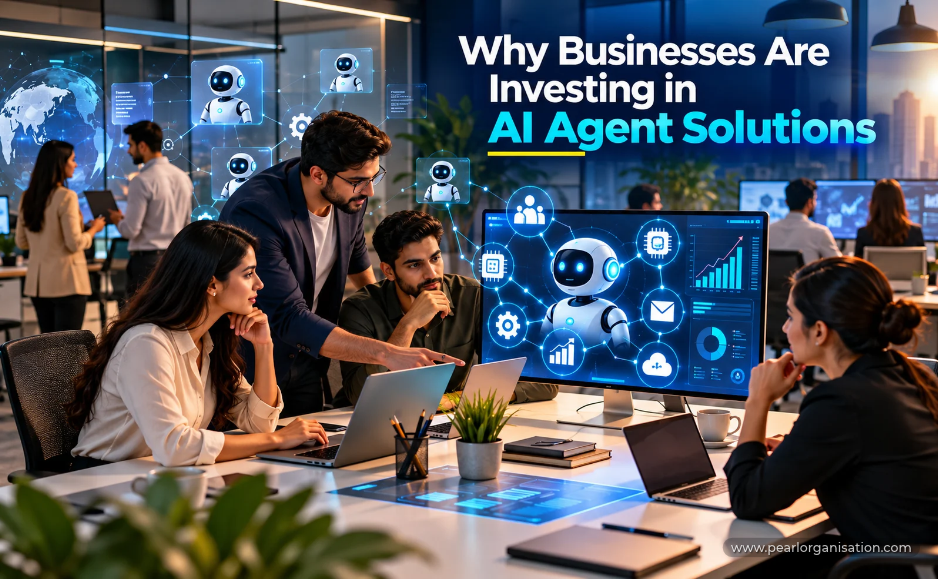
The appeal of AI agent solutions for businesses is not novelty. It is that agents can take on the semi-structured work that rules-based automation never reached: reading an email, checking three systems, drafting a response and updating a record. That work consumes a large share of operational hours in almost every company.
Business Process Automation Using AI Agents
Business process automation using AI agents works best where a process has high volume, variable inputs and a clear definition of a good outcome. The table below shows common starting points and the metric that should decide whether the agent is working.
Function | Example agent | Metric to track |
Customer support | Triage and resolution agent that reads tickets, checks order data and drafts replies | First-response time, resolution rate, escalation rate |
Finance | Invoice matching and reconciliation agent | Cycle time, exception rate |
Sales operations | Lead qualification and CRM update agent | Speed to lead, data completeness |
HR | Onboarding and policy question agent | Time to productivity, ticket volume |
IT operations | Incident triage agent | Mean time to resolve |
Legal and procurement | Contract review and clause comparison agent | Review time, missed-clause rate |
Notice that every row pairs an agent with a metric. A partner who cannot explain how success will be measured before building is selling a demo, not a solution.
Trends Shaping AI Agent Development in 2026
The market is moving quickly, and a good partner should be able to explain where it is heading. Four shifts deserve attention when you evaluate vendors this year.
• From single agents to multi-agent systems. Complex workflows are increasingly split across specialist agents, such as one for retrieval, one for analysis and one for action, coordinated by an orchestrator.
• Standard ways to connect tools. Open protocols for tool and data access are making integrations easier to build and easier to swap, which reduces vendor lock-in.
• Stronger governance expectations. Boards, auditors and regulators now ask who approved an agent’s actions and how errors are caught. Logging and human review are becoming defaults.
• Evaluation as a discipline. Teams that treat testing as a continuous engineering practice, not a one-off check, ship more reliable agents.
Ask each shortlisted vendor how these shifts affect its architecture. A confident answer suggests the team is learning from live projects. A generic answer suggests it is repeating marketing.
Build In-House, Buy a Platform or Hire an AI Agent Development Company?
Before searching for vendors, settle the build-versus-buy question honestly. Each route suits a different stage of maturity.
• Build in-house when AI agents are core to your product or competitive edge, and you can hire and retain scarce engineers. Expect a long ramp-up and ongoing investment in evaluation and operations.
• Buy a platform when the use case is standard, such as a support assistant, and customisation needs are modest. Check how much control you have over data, prompts and exports.
• Hire a partner when you need custom workflows, integration with existing systems and speed, but do not want to build a full AI team. Here, a specialist or full-service provider carries the engineering load while your team owns the business outcome.
Many organisations blend these routes: a partner builds and launches the first agents, while an internal team gradually takes over day-to-day ownership. If that is your plan, make knowledge transfer an explicit part of the contract.
Types of AI Agent Development Partners
Before comparing individual vendors, decide which category of AI agent development partner fits your situation. Each category has a different cost profile and a different way of failing.
Partner type | Typical strengths | Typical limitations |
Global consultancies and system integrators | Scale, governance experience, board-level credibility | High cost, slower delivery, junior teams on execution |
Specialist AI agent boutiques | Deep agent expertise, fast experimentation | Narrow scope, limited support for wider system integration |
Full-service digital transformation companies | Agents plus ERP, CRM, cloud and security under one roof | Quality varies; check for dedicated AI engineering depth |
Platform and no-code vendors | Low upfront cost, quick pilots | Limited customisation, platform lock-in, ceiling on complexity |
Many mid-sized and large organisations find that a full-service digital transformation company with real AI engineering depth gives the best balance, because agents rarely live alone. They need to plug into the systems a business already runs.
How to Choose an AI Agent Development Company: 10 Criteria That Matter
If you are wondering how to choose an AI agent development company, use the following ten criteria as a working checklist. They are ordered roughly by how often they separate strong vendors from weak ones.
1. Production Track Record, Not Demo Polish
Ask to see an agent running in a live environment, even if the client is anonymised. A demo on curated data proves little. A production agent handling real, messy inputs proves a great deal. Ask what went wrong in the first month and how the team fixed it.
2. A Named Technology Stack and Architecture Depth
A strong team can tell you which models it uses and why, how it handles memory and retrieval, which orchestration framework it prefers and how it avoids dependence on a single model provider. Vague answers such as “proprietary AI engine” are a warning sign.
3. A Written Evaluation Method
Every agent makes mistakes. The question is whether the vendor measures them. Look for test sets built from your own data, accuracy and safety thresholds agreed in advance, and regression testing whenever a prompt, model or tool changes.
4. Security, Privacy and Compliance
Agents touch sensitive data and can take actions, so the risk is larger than with a chatbot. Check role-based access, encryption, audit logs, data-retention rules and where data is processed. Ask whether your data is used to train any third-party model.
5. Integration Capability
An agent that cannot reach your CRM, ERP, ticketing tool or document store is a conversation, not an automation. Confirm the provider has delivered API integrations, handled legacy systems and built secure connectors before.
6. Domain Understanding
A team that understands your industry will pick better use cases and anticipate edge cases. Ask for examples from your sector or a closely related one, and speak to the people who would actually deliver your project.
7. Transparent Delivery Process
Look for a phased approach with defined deliverables, regular demos and clear decision points. Agile delivery with visible sprint outputs lets you correct course early instead of discovering problems at handover.
8. IP Ownership and Exit Options
Clarify who owns the code, prompts, evaluation sets and fine-tuned assets. Insist on documentation and handover rights so that changing vendors later does not mean starting over.
9. Post-Launch Support and Agent Operations
AI agent development does not end at deployment. Models change, data drifts and business rules evolve. A good partner offers monitoring, incident response and scheduled improvement cycles, ideally with round-the-clock support for business-critical agents.
10. Commercial Clarity and Cultural Fit
Pricing should be explained in plain terms, including run costs such as model usage. Equally important is whether the team communicates honestly, challenges unrealistic scope and treats your goals as its own. The best vendor relationships feel like a partnership from the first call.
Scoring these ten areas consistently across vendors matters more than any single answer. A company that is excellent on four criteria and silent on the rest has not earned your trust yet. The scorecard later in this guide turns the list into a side-by-side comparison you can share with your leadership team.
Where AI Agent Solutions Deliver Value: Industry Examples

Good partners bring pattern knowledge from your sector. The examples below show the kinds of agents that tend to reach production first, and they make useful prompts for your own discovery workshop.
• Banking and financial services: KYC document checking, loan-file preparation and customer query resolution, always with human sign-off on credit decisions.
• Retail and e-commerce: order-status and returns agents, catalogue enrichment and personalised outreach.
• Logistics and transport: shipment exception handling, documentation checks and customer updates.
• Healthcare administration: appointment management, claims preparation and records summarisation, with strict privacy controls.
• Education: admissions support, student query handling and content preparation for teachers.
• Software and services firms: support triage, internal knowledge assistants and automated reporting.
Notice the pattern: in regulated settings, the agent prepares and recommends, while a person approves. A partner who designs these handoffs well will protect you from both operational and reputational risk.
Enterprise AI Agent Development: What Changes at Scale
A single agent in one department is a project. Agents across an organisation are a capability, and enterprise AI agent development needs a different level of discipline. Four themes matter most.
• Governance: define what each agent may read, write and approve, and which actions always need a human decision.
• Identity and access: treat agents like employees with scoped permissions, not as shared super-users.
• Observability: log prompts, tool calls, outputs and costs so that any decision can be audited.
• Change management: train staff, update job descriptions and give teams a clear path to flag agent errors.
Ask any prospective provider how it has handled these themes for large clients. If the answer is limited to model selection, the vendor has not yet operated at enterprise scale.
AI Agent Implementation Services: What a Good Delivery Process Looks Like
Strong AI agent implementation services follow a predictable shape. Use the sequence below to test whether a vendor’s plan is realistic.
1. Discover: map the workflow, quantify the current cost and agree on success metrics.
2. Design: define agent responsibilities, tools, data sources, guardrails and escalation paths.
3. Prototype: build a narrow version against real data and test it with the people who do the work today.
4. Pilot: run the agent in a limited, monitored production setting with humans reviewing outputs.
5. Scale: harden security, expand coverage, connect more systems and train wider teams.
6. Operate: monitor quality and cost, retrain evaluation sets and release improvements on a schedule.
Be sceptical of any proposal that promises a fully integrated, enterprise-grade agent in two weeks. A focused pilot can be fast. A production system with security, integrations and governance takes longer, and honest vendors say so.
How to Measure the Return on an AI Agent Project
Return on investment should be defined before build begins; otherwise, every result can be explained away later. Start with a baseline: how long does the process take today, how many people touch it, what does an error cost, and how often does it happen? After the pilot, compare the same figures.
• Efficiency: hours saved per week, cycle-time reduction and cost per transaction.
• Quality: error rate, rework rate and customer satisfaction scores.
• Capacity: volume handled without extra headcount, and how quickly peaks are absorbed.
• Risk and compliance: audit findings, policy breaches and escalation accuracy.
• Total cost: build cost plus monthly model, infrastructure and support costs.
Ask prospective vendors how they report these numbers. A partner confident in its work will agree to a measurement plan up front and review results with you at each milestone.
Choosing an AI Agent Development Company in India

Why Global Buyers Look at an AI Agent Development Company in India
India has become a major centre for AI engineering, combining a deep talent pool, strong English-language delivery and competitive pricing. For many organisations in North America, Europe, the Middle East, Africa and Asia-Pacific, an AI agent development company in India offers broader scope for a given budget than equivalent teams in higher-cost markets. Time-zone overlap with Asia, the Middle East and Europe, and the ability to run extended support windows, add further value.
What to Expect From AI Agent Development Services in India
AI agent development services in India now range from small specialist studios to global IT companies. Quality varies widely, so apply the same ten criteria you would anywhere else, then add checks for delivery maturity: documented processes, named account leadership, independent reviews and the ability to support clients in several countries at once.
Data Protection and the DPDP Act
For any business handling personal data of people in India, the Digital Personal Data Protection (DPDP) Act is now a core design requirement. An AI automation company in India worth hiring should be able to explain how consent, purpose limitation, data minimisation and breach response will be built into your agents, and where data will be stored and processed. Buyers outside India should also confirm alignment with rules that apply to them, such as GDPR.
AI Agent Solutions for Businesses in India: Where Demand Is Strongest
AI agent solutions for businesses in India are growing fastest in banking and financial services, e-commerce and retail, logistics, healthcare administration, education and software-as-a-service. These sectors share high transaction volumes, multilingual customers and heavy back-office work, which is exactly where agents deliver measurable returns.
When shortlisting an AI agent development company in India buyers can trust, ask for references from clients outside India, evidence of multi-country delivery and proof that support teams can respond outside standard business hours.
It also helps to test responsiveness before you sign. Send the same short brief to two or three shortlisted companies and compare how quickly and how specifically they respond. The vendor that asks sharp questions about your data, users and metrics is usually the one that will manage the project well.
AI Agent Development Cost and Pricing Models
Pricing differs by scope, integrations and compliance requirements, so beware of any vendor who quotes a number before understanding your workflow. One published industry estimate places a focused single-workflow agent at roughly $10,000 and complex multi-agent enterprise systems above $200,000. Treat those figures as a rough range, not a quote. Three pricing structures dominate:
• Fixed-price pilot: best for a clearly bounded first use case with defined acceptance criteria.
• Time and materials or dedicated team: best when scope will evolve and you want flexibility.
• Managed subscription or outcome-linked: best for ongoing operation, where fees reflect usage or business results.
Whatever the model, budget for run costs as well as build costs. Model usage, hosting, monitoring and periodic retuning continue after launch, because agents are never truly finished.
Common Mistakes Businesses Make When Hiring an AI Agent Development Company
Even careful buyers fall into a few predictable traps. Knowing them in advance saves months.
• Starting with the technology instead of the process. The question is not “where can we use agents?” but “which workflow costs us the most and fails most often?”
• Choosing on price alone. The cheapest quote often omits integration, evaluation and support, which are the parts that decide success.
• Skipping the pilot. A small, measured pilot reveals data quality, user adoption and integration issues before they become expensive.
• Ignoring the people side. Staff who do not trust or understand the agent will work around it. Budget for training and communication.
• Treating launch as the finish line. Agents need monitoring and tuning. Without it, quality quietly declines.
Red Flags When Evaluating an AI Agent Development Partner
• No live production example, or only a scripted demo.
• Unwillingness to name the models, frameworks or cloud services involved.
• No written evaluation approach, or accuracy claims with no test data behind them.
• Promises of 100% accuracy or full autonomy from day one.
• Vague answers on data residency, access control or audit logging.
• Unclear ownership of code, prompts and evaluation assets.
• Pressure to sign quickly, or pricing that ignores run costs.
• No plan for support or monitoring after go-live.
Questions to Ask on the First Call
1. Can you show an agent in production, and what did it cost to run last month?
2. Which models and orchestration tools do you use, and how do you avoid lock-in?
3. How will we measure accuracy, and who builds the test set?
4. How is our data stored, who can access it, and is it used for training?
5. Who owns the code, prompts and evaluation assets?
6. Who will actually work on our project, and where are they based?
7. What does support look like after launch, including out-of-hours incidents?
8. What would make you advise us not to build this agent?
Pearl Organisation: A Practical AI Agent Development Partner

Every framework in this guide eventually meets a real vendor, so here is how Pearl Organisation measures up. Founded in 2017 and headquartered in Dehradun, India, Pearl Organisation is a global IT and digital business transformation company whose clients span more than 150 countries. Its team of 250+ agile professionals has delivered over 21,000 projects for more than 11,600 customers across 20+ industries, with a reported 96% project success rate.
As a Pearl Organisation AI development company, the firm approaches agents as part of a wider transformation story rather than as an isolated experiment. Its Pearl Organisation AI agent development practice sits alongside application development, cloud, API management, ERP, CRM, cybersecurity and digital process automation. That breadth matters because the hardest part of any agent project is rarely the model. It is connecting the agent to the systems, data and people that already run the business.
The company’s Pearl Organisation AI solutions range from AI integration and agent development to AI, data and analytics services, and it has built an AI assistant of its own, Pearl Assistant, as a working example of the approach. Its Pearl Organisation AI automation services build on years of digital business automation work using its ERP, CRM and CMS products, which means process knowledge arrives with the engineering. Together, these Pearl Organisation AI development services are supported by an agile delivery process, 24x7x365 on-demand support, secured products and a premium consultation offered at no cost.
For buyers in India, Pearl Organisation combines local delivery with a track record of serving international clients, which is exactly the profile recommended in the previous section. For buyers elsewhere, it offers a global client base with India-based engineering depth. In either case, the right first step is a short discovery conversation to test the fit against the ten criteria above. You can explore the company’s offering at pearlorganisation.com or request a consultation through its website.
AI Agent Development Company Scorecard
Use this simple weighted scorecard to compare two or three shortlisted vendors. Score each criterion from 1 to 5, multiply by the weight and total the result. Adjust the weights to reflect your priorities.
Criterion | Suggested weight | Vendor A | Vendor B |
Production track record | 20% |
|
|
Technical stack and architecture | 15% |
|
|
Evaluation and quality method | 15% |
|
|
Security and compliance | 15% |
|
|
Integration capability | 10% |
|
|
Delivery process and transparency | 10% |
|
|
Post-launch support | 10% |
|
|
IP ownership and commercial clarity | 5% |
|
|
Common Questions About AI Agent Development Companies
What does an AI agent development company do? It designs, builds, integrates and maintains autonomous software agents that reason, use tools and complete multi-step tasks, including the evaluation, security and support work needed to run them reliably.
How do I choose an AI agent development company? Judge vendors on production evidence, a named technology stack, written evaluation methods, security practices, integration skill, delivery transparency, IP terms and post-launch support, then run a small paid pilot before committing.
How much do AI agent development services cost? Costs depend on scope, integrations and compliance. A focused single-workflow agent costs far less than a multi-agent enterprise system. Always ask for build and run costs separately.
Is an AI agent development company in India a good choice for global businesses? Often yes, provided the vendor shows multi-country delivery experience, strong security and data-protection practices and reliable support hours. Verify these through references, not brochures.
How long does AI agent implementation take? A narrow pilot can take a few weeks. A production deployment with enterprise integrations, security reviews and change management usually takes several months, depending on scope.
What makes Pearl Organisation different as an AI automation partner? Pearl Organisation pairs AI agent development with broader digital transformation capability, a global client base across 150+ countries, agile delivery and round-the-clock support, so agents are built into your wider systems rather than bolted on.
Conclusion: Choose a Partner, Not Just a Provider
The best AI agent projects are not won on model choice. They are won by partners who define success before they build, test quality continuously, protect data, integrate cleanly with existing systems and stay accountable once the agent is live. Whether you search for a global AI agent development company or a specialist AI agent development company in India, the ten criteria in this guide will help you separate substance from marketing.
Start small, measure honestly and scale what works. If you would like to test your use case with a team that delivers AI agent solutions for clients worldwide, talk to Pearl Organisation about a no-cost discovery consultation.





 150+
150+
 250+
250+
 21,000+
 11,600+