
How to Use AI to Transform Your Branding and Design Agency
Introduction: Why Every Branding and Design Agency Needs an AI Strategy Now
Three years ago, most branding and design agencies treated AI as an experiment. The output quality was uneven, the tools were fragmented, and the professional consensus was that AI could handle templated work but could not touch the strategic, conceptual layer of brand building.
That consensus is obsolete in 2026. According to McKinsey, generative AI can reduce design and prototyping cycles by up to 70% when embedded properly across creative workflows. The generative AI in creative industries market has grown from USD 4.06 billion in 2025 to USD 5.38 billion in 2026, at a CAGR of 32.3%. As Flatline Agency's 2026 analysis observes, 'The most productive brand teams are no longer asking which single AI tool to use. They are building stacks where each tool handles a specific stage of the creative workflow. The tool is not the strategy. The workflow is.'
The shift in 2026 is not about the speed of generation; that was the 2023 story. The leading question for branding and design agencies now is whether AI output is commercially safe, brand-consistent, and scalable without creative drift. Adobe Firefly's IP indemnification model, Canva AI 2.0's Brand Intelligence layer, and Claude Design's automatic design system integration all reflect this maturation from generation-speed to production-reliability.
For branding and design agencies in India and globally, the competitive dynamics are clear: agencies that have integrated AI into their core workflows are delivering more design options, faster iteration, deeper data-driven brand strategy, and lower cost per deliverable than those operating with purely human-only processes. This guide covers how to make that transition, intelligently, strategically, and without losing the human creative advantage that differentiates great branding from generated output.
1. How AI Is Transforming Branding and Design Agencies in 2026
The transformation of branding through AI is not a single event, it is a progressive integration across every dimension of how agencies operate. Successful-Blog's 2026 analysis characterises the shift precisely: 'Branding is no longer just about visual identity, it is becoming a dynamic, data-driven ecosystem that evolves continuously with consumer behaviour. Brands are not only competing on creativity but also on intelligence.
1.1 AI Generates Multiple Design Options Rapidly
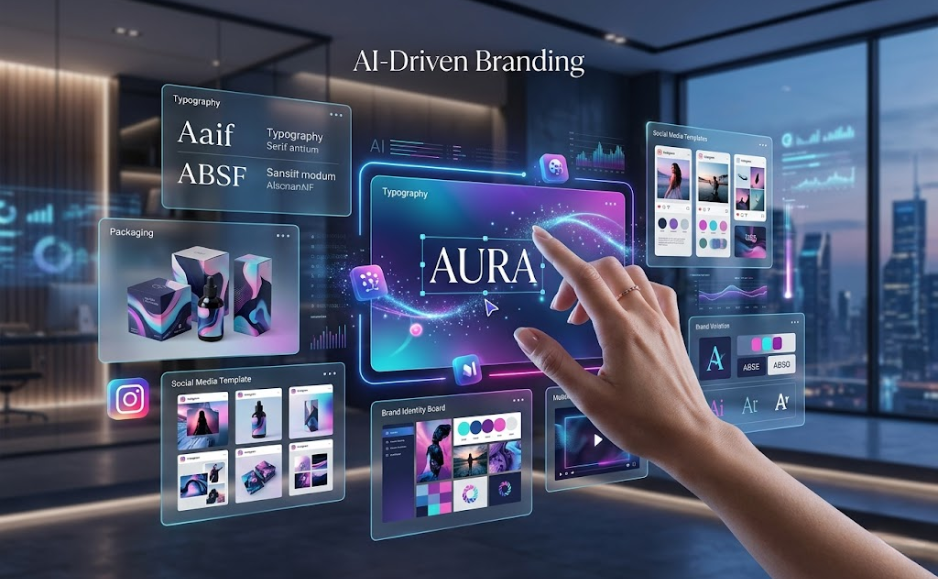
The most immediately visible impact of AI on design agencies is the dramatic acceleration of the ideation and iteration phase. Where a creative team previously spent days developing three to five logo concepts, brand colour directions, or campaign visuals, AI tools now generate dozens of options in hours, allowing agencies to explore a far wider solution space before committing to a direction.
This is not a replacement of creative direction; it is a change in where creative energy is applied. Designers using AI generation tools spend less time on the execution of initial concepts and more time on curation, refinement, and the strategic judgement that separates good brand identities from great ones. The client experience also improves: presenting 12 differentiated directions rather than 4 gives clients genuine choice and demonstrates the exploratory rigour that justifies agency fees.
Practically, AI tools generate multiple design options rapidly across: logo mark explorations, typography pairings, colour palette variations, brand pattern systems, social media template families, advertising layout options, and packaging concepts. The speed of generation has reached a point where real-time iteration in client presentations, generating variations based on live client feedback, is now a standard capability for AI-equipped agencies.
1.2 AI Assists with Time-Consuming Production Tasks
Beyond ideation, AI removes the friction from the production tasks that consume disproportionate agency time without contributing strategic value. The production work that AI handles most effectively in 2026:
Asset resizing and format adaptation: automatically resizing brand assets across the hundreds of format specifications required for digital advertising, different dimensions for Instagram Stories, LinkedIn banners, Google Display Network, Meta Feed, and dozens more, is one of the most time-consuming and least strategically valuable tasks in any design agency's workflow. AI-powered tools handle this automatically, maintaining aspect ratios, focal points, and brand consistency across formats.
Background removal and image editing: object isolation, background replacement, and compositional adjustments that previously required skilled Photoshop work are now handled in seconds. This frees designers for compositional and conceptual work rather than technical execution.
Brand material variation generation: once a core brand system is established, AI generates the full range of collateral variations, email headers, presentation templates, report covers, social media content calendars, maintaining brand consistency at scale without manual recreation of each asset.
Copy and content variations: AI-assisted copywriting generates multiple headline, tagline, and body copy variations for testing, accelerating the A/B testing cycle and enabling data-driven optimisation of messaging without proportional increases in creative resource.
1.3 Modern AI Analyses Customer Data to Generate Brand Materials
The most strategically significant AI application in branding in 2026 goes beyond visual production. Modern AI systems analyse customer data, purchase behaviour, engagement patterns, sentiment analysis across social and review platforms, demographic signals, and competitive positioning data, to generate brand materials that are strategically grounded in what actually resonates with the target audience rather than what the creative team assumes will resonate.
BrandedAgency.com's 2026 analysis captures this shift: 'AI agents analyse audience behaviour, surface emerging trends, and generate fresh marketing ideas, empowering creative teams to focus on strategic vision and storytelling.' David Caron Design's concurrent research confirms: 'AI has evolved beyond automation. Businesses now use artificial intelligence to analyse customer behaviour, predict trends, and create personalised marketing campaigns.'
In practice, this means: AI analyses social listening data to identify the visual aesthetics, language patterns, and emotional themes that resonate most strongly with a brand's target demographic; AI processes competitor brand audit data to identify positioning gaps and visual differentiation opportunities; and AI synthesises customer sentiment data to recommend messaging angles and brand voice adjustments that align with evolving audience expectations.
2. AI-Driven Branding & Design Tools: The 2026 Agency Stack

The 2026 AI branding tool landscape has matured from a collection of experimental generators into a structured stack where specialised tools handle specific workflow stages. As Flatline Agency notes, the leaders are 'building stacks where each tool handles a specific stage of the creative workflow', not pursuing a single all-in-one solution.
DesignRush's 2026 AI branding tools analysis emphasises a critical selection principle from Liam Broadbent, Director of Broadwise Solutions: 'With so many tools out there, it's easy to jump between platforms, try too much, and end up with a bloated process that slows everything down.' The right stack is the minimum number of well-integrated tools that cover the agency's core workflow, not the maximum number of impressive capabilities.
Workflow Stage | Leading AI Tools (2026) | Primary Function | Typical Time Saving |
Brand Strategy & Positioning | BrandingGPT, AI Brand Strategist, Claude/GPT-4o | Brand name generation, positioning frameworks, competitive analysis, tone of voice development | 40–60% vs manual research and strategy synthesis |
Visual Identity Generation | Adobe Firefly, Midjourney, DALL-E 3, Canva AI 2.0 | Logo concept exploration, colour palette generation, brand pattern creation, iconography | 60–70% vs manual initial concept development |
Design System Development | Claude Design, Figma AI, uBrand | Component library generation, brand guideline documentation, design token creation | 50–65% vs manual system documentation |
Content & Marketing Materials | Canva AI 2.0, Adobe Express AI, Jasper, Copy.ai | Social media templates, advertising creatives, email designs, presentation templates | 70–80% vs manual production per asset |
Brand Voice & Copy | BrandingGPT, Jasper, Claude, ChatGPT | Tagline generation, website copy, advertising copy, tone-of-voice consistency checking | 50–70% vs manual copy development |
Customer Data Analysis | Sprout Social AI, Brandwatch, Semrush Brand Monitor | Social listening, sentiment analysis, competitor brand tracking, audience insight generation | 80–90% vs manual data analysis |
Brand Visibility (GEO) | Brandi AI, Semrush AIO Tracker, BrandMentions | AI search citation tracking, GEO optimisation, brand presence in LLM answers | New capability — previously unavailable |
Asset Management & Delivery | Bynder AI, Brandfolder, Frontify | Brand asset organisation, automated format adaptation, brand compliance checking | 60–75% vs manual asset management |
The Tools Defining 2026 Specifically
Three tool launches in 2026 have been particularly significant for branding and design agencies:
Claude Design (April 2026): Anthropic's Claude Design enables founders, product managers, and marketers to generate complete, interactive prototypes without opening Figma or briefing a designer. As Flatline Agency's analysis notes: 'The expansion of who can produce design work is the real shift, not just the speed of production.' This has significant workflow implications for agencies; client-side team members can now generate viable first drafts, changing the agency's role toward refinement and strategic direction rather than initial execution.
Canva AI 2.0 Brand Intelligence: the Brand Intelligence layer in Canva AI 2.0 learns a brand's visual system, colours, typography, logo usage rules, and tone of voice and enforces consistency automatically across all AI-generated content. This addresses one of the most persistent complaints about AI in branding: output that looks impressive in isolation but drifts from brand guidelines when deployed at scale.
Adobe Firefly IP Indemnification: Adobe's commitment to indemnifying commercial use of Firefly-generated content removes the legal uncertainty that has prevented many agencies from deploying AI-generated visual assets in commercial campaigns. This is a production-environment change, not just a feature update; it addresses the 'commercially safe' requirement that Flatline identifies as the defining question of 2026 AI adoption.
3. AI for Branding and Marketing: Transforming the Strategy Layer
The most durable competitive advantage from AI in branding is not faster logo generation; it is superior strategic intelligence. Agencies that apply AI to the research, insight, and strategy development phases of brand work can deliver client recommendations grounded in comprehensive data analysis that would have taken weeks to compile manually and cost significantly more to produce.
3.1 AI-Powered Brand Audit and Competitive Intelligence
Traditional brand audits rely on manual review of competitor materials, customer survey data, and creative team assessment. AI-powered brand audits supplement this with continuous, comprehensive analysis:
Visual identity benchmarking: computer vision tools analyse the visual identities of every significant competitor in a market, colour palette usage, typography patterns, logo style trends, imagery styles, identifying market conventions and differentiation opportunities that human analysis would require weeks to compile.
Sentiment and perception analysis: AI natural language processing tools analyse customer reviews, social media comments, forum discussions, and earned media across a brand and its competitors, producing real-time perception maps that reveal how customers actually experience a brand versus how the brand intends to be perceived.
Content performance analysis: AI tools analyse which content formats, visual styles, messaging angles, and posting cadences generate the highest engagement across a brand's category, informing creative strategy with performance data rather than creative intuition alone.
Brand consistency scoring: AI scanning tools assess brand guideline compliance across every digital touchpoint, website, social channels, advertising, email- identifying inconsistencies that erode brand equity over time.
3.2 AI-Powered Personalisation at Scale
Modern AI analyses customer data to generate brand materials that are personalised to specific audience segments, moving beyond the single brand identity deployed uniformly to all audiences toward dynamic brand expression that adapts to context while maintaining core identity consistency.
In practice for branding agencies: AI analyses demographic, behavioural, and psychographic data to identify distinct audience segments within a client's customer base; generates messaging, imagery, and creative direction recommendations optimised for each segment; and enables A/B testing of personalised brand expressions at a scale and speed that manual creative processes cannot match.
The personalisation capability is particularly powerful for digital advertising and content marketing: AI can generate dozens of creative variations for a campaign, different headlines, imagery styles, calls to action, and continuously optimise allocation toward the versions generating the highest engagement and conversion, with minimal manual intervention.
3.3 Predictive Brand Strategy
Successful-Blog's 2026 analysis identifies predictive intelligence as a defining capability of leading AI branding systems: 'AI-driven systems are transforming branding into something far more adaptive, in 2026, AI-driven systems are transforming branding into a dynamic, data-driven ecosystem that evolves continuously with consumer behaviour.'
Predictive brand strategy applications include: trend forecasting (AI analyses cultural, social, and market signals to identify emerging aesthetic and messaging trends before they become mainstream); brand health early warning (continuous monitoring of brand sentiment data with anomaly detection that flags perception shifts before they manifest as commercial impact); and campaign outcome prediction (AI models trained on historical campaign performance data predict the likely engagement, conversion, and brand-lift outcomes of proposed creative directions before any spend is committed).
4. AI Marketing Automation for Agencies: Operational Transformation

Beyond creative applications, AI marketing automation is transforming the operational and delivery model of branding and design agencies, reducing non-billable overhead, improving client reporting, and enabling smaller teams to manage larger client portfolios without proportional increases in headcount.
4.1 Client Reporting and Performance Intelligence
Manual client reporting, aggregating data from multiple platforms, formatting it into presentable reports, adding narrative interpretation, consumes significant agency time that generates no direct creative value. AI marketing automation for agencies handles this entirely:
Automated cross-platform data aggregation: AI tools pull performance data from Google Analytics, social platforms, advertising platforms, email marketing tools, and SEO trackers, combining them in unified dashboards that update in real time.
Natural language report generation: AI converts performance data into structured narrative reports with insight interpretation, identifying what improved, what declined, what drove changes, and what actions are recommended. Agency strategists review and add client-specific context rather than building reports from scratch.
Anomaly detection and proactive alerts: AI monitors client performance metrics continuously and alerts account teams when significant changes occur, brand mention spikes, traffic drops, or engagement rate changes, enabling proactive rather than reactive client communication.
4.2 Project and Workflow Automation
Brief parsing and scoping: AI tools analyse client briefs and automatically extract project requirements, identify missing information, and generate structured scope documents and timeline estimates, reducing the back-and-forth that typically delays project kick-off.
Asset organisation and tagging: AI automatically tags, categorises, and organises design assets in brand libraries, making assets searchable by colour, style, format, and campaign, eliminating the manual asset management overhead that plagues large agencies.
Quality and compliance checking: AI brand compliance tools automatically check every deliverable against brand guidelines before client delivery, flagging incorrect colour usage, typography violations, logo size infractions, and tone-of-voice inconsistencies.
Client communication drafting: AI drafts status updates, feedback requests, and project milestone communications, which account managers review and personalise, reducing the writing time that account teams spend on routine communications.
4.3 Scaling Creative Output Without Scaling Headcount
The most significant operational impact of AI marketing automation for agencies is the decoupling of creative output volume from headcount. An agency with 10 designers using a well-integrated AI stack can deliver the output volume that previously required 15–20, with the human team focused on strategic direction, client relationship management, and the creative refinement that AI cannot perform autonomously.
This changes the economics of agency growth: capacity increases come from workflow investment rather than headcount alone, margins improve as the ratio of AI-assisted production time to billable hours shifts, and the agency can offer faster turnaround and lower per-asset pricing without reducing per-project profitability.
5. AI for Digital Marketing Agencies: The Complete Integration Roadmap

Transforming a branding and design agency with AI is a programme, not a tool selection decision. The following roadmap reflects the integration sequence that delivers sustainable results, building capability progressively rather than attempting wholesale transformation in a single phase.
Phase 1: Foundation (Weeks 1–4)
Audit and strategy before tool selection. Identify the three to five workflows in your agency that consume the most non-billable time or that are the most significant bottlenecks between client brief and deliverable. These are the highest-leverage AI integration points.
Map your current workflow: document each stage of your core service delivery process, strategy, concepting, design, production, review, and delivery. Note time spent per stage, the skill level required, and the strategic value of each stage to the client outcome.
Identify AI integration points: match the high-time, low-strategic-value stages with available AI tools. Prioritise stages where AI can reduce time by 50%+ without reducing output quality.
Select a minimum viable stack: start with 2–3 tools that address your highest-priority integration points. Add complexity only after the initial tools are embedded in the workflow and are generating reliable output.
Establish brand consistency protocols: before using AI generatively in client work, define how you will maintain brand consistency in AI outputs, which tool handles brand intelligence, how guidelines are encoded, and how compliance is checked before delivery.
Phase 2: Integration (Weeks 5–12)
Build AI into existing workflows, measure the time impact, and train the team on effective prompting and output curation.
Prompt library development: build a library of tested, effective prompts for your most common creative tasks. The quality of AI output is directly proportional to the quality of the input, a structured prompt library is an agency intellectual property asset.
Output quality standards: define what good AI-assisted output looks like for each deliverable type and document the curation criteria, what gets used, what gets refined, and what gets discarded. This maintains quality consistency across team members with different levels of AI tool experience.
Client communication protocols: establish how you communicate AI's role in your workflow to clients. The most effective approach in 2026 is transparent, AI accelerates production and expands the range of options explored; human expertise directs, curates, and refines the output. Most clients respond positively to this framing when the output quality and value delivered support it.
Measurement baseline: track time per deliverable type before and after AI integration. These measurements are the evidence base for workflow investment decisions and client pricing strategy adjustments.
Phase 3: Optimisation (Months 3–6)
Data feedback loops: integrate client performance data into your creative strategy process. Use AI analytics tools to build the connection between creative decisions and measurable outcomes, building institutional knowledge about what works for which client types and categories.
AI-assisted pitching: use AI to generate richer pitch materials, more concept directions, faster research synthesis, better competitive intelligence, without proportional increases in pitch preparation time. The agency that presents 12 differentiated strategic directions in a pitch versus a competitor presenting 4 has a significant conversion advantage.
White-label and capacity partnerships: consider whether AI-enabled capacity makes white-label delivery of services to other agencies viable, a revenue diversification opportunity that AI workflow efficiency makes possible at margins that manual-only agencies cannot sustain.
6. AI-Powered Branding Solutions: Use Cases Across Brand Types
Different brand contexts require different AI branding applications. The following use cases illustrate how AI-powered branding solutions deliver measurable value across the spectrum of client types a branding and design agency serves:
Brand Type | Highest-Value AI Application | Key AI Tools | Measurable Outcome |
Start-up / Early Stage | Rapid brand identity exploration from positioning brief; 30-minute naming shortlist generation; MVP brand system without full agency engagement | BrandingGPT, Canva AI, Adobe Firefly, AI Brand Strategist | Brand identity delivered in days vs weeks; 60–70% cost reduction vs traditional agency |
Scale-up / Growth Stage | Personalised content at scale; A/B testing of messaging variants; AI-driven social content calendar across 4–5 platforms simultaneously | Jasper, Canva AI 2.0, Sprout Social AI, Brandwatch | 3–5x content output; 40–60% reduction in content production cost per piece |
Enterprise Brand Management | Brand consistency enforcement at scale; real-time brand health monitoring; predictive trend analysis for brand evolution planning | Bynder AI, Brandfolder, Brandwatch, Adobe Firefly | Brand compliance rate improvement from 70% to 95%+ across touchpoints |
B2B Technology Companies | Thought leadership content strategy from data analysis; competitor positioning gap identification; technical content simplification | Claude, BrandingGPT, Semrush Brand Monitor, LinkedIn AI | LLM citation rates; Share of Voice in AI search; pipeline-attributed thought leadership |
Retail & Consumer Brands | AI-generated campaign creative variations for performance testing; seasonal content automation; product packaging concept exploration | Midjourney, DALL-E 3, Adobe Firefly, Copy.ai | Campaign creative testing velocity; reduced cost per high-performing creative variant |
Local & Regional SMBs | Accessible brand identity creation; consistent local marketing material generation; review and reputation management support | Canva AI, uBrand, Google Business Profile AI tools | Professional brand consistency previously required full-service agency investment |
7. The Human + AI Balance: Where Creativity Still Wins
The most important principle in AI integration for branding agencies is understanding the creative and strategic work that AI cannot do, and ensuring that the time saved on production is reinvested in the irreplaceable human capabilities that define agency value.
BrandedAgency.com's 2026 analysis articulates the balance precisely: 'As immersive experiences grow, AI supports rapid prototyping of interactive layers, yet human designers contextualise experiences for target psychographics.' The distinction is between generation and contextualisation: AI can generate at scale; humans provide the cultural, emotional, and strategic context that makes generated output meaningful and differentiated.
What AI Cannot Replace in Brand Work?
Original creative vision and conceptual thinking: the strategic insight that identifies an unexpected brand positioning angle, the conceptual leap that makes a brand identity genuinely distinctive rather than competently executed, remains a human creative capability. AI can explore thousands of variations within a defined solution space; humans define the solution space.
Emotional intelligence and cultural sensitivity: brand work that resonates requires understanding of the cultural, social, and emotional context in which a brand will operate. AI systems can analyse sentiment data at scale; they cannot reliably navigate the nuanced cultural sensitivities, regional variations, and emotional undercurrents that determine whether a brand feels authentic or tone-deaf to its intended audience.
Client relationship and trust: the client relationship in brand work is built on demonstrated understanding of the client's business, market, and ambitions, and on the trust that comes from being known as a strategic partner, not a production vendor. This relationship is a human capability that AI cannot replicate and should not be allowed to displace.
Ethical judgement and brand values stewardship: decisions about what a brand should and should not be associated with, how it should respond to social issues, and where its boundaries lie require ethical and strategic judgement that reflects the brand's values, a fundamentally human responsibility.
Novel synthesis across domains: the most distinctive creative solutions often come from connecting ideas across domains that have no prior relationship, applying an insight from architecture to a food brand, or from music to a technology identity. This kind of lateral creative synthesis is not within AI's current capability.
8. How to Hire an AI Branding Agency: The Evaluation Framework
For businesses seeking to hire an AI branding agency in India or globally, the market is noisy — every agency now describes itself as AI-powered. The following evaluation criteria separate agencies that have genuinely integrated AI into their methodology from those that have added AI terminology to unchanged processes.
7 Questions to Ask Any AI-Based Design Agency
Show me your AI-assisted workflow in practice: ask the agency to demonstrate, not describe, how AI is integrated into their brand development process. A genuine AI branding agency can walk you through a specific recent project and show which stages were AI-assisted, what the AI output looked like, and how the human creative team shaped and refined it.
How do you ensure brand consistency in AI-generated outputs? The most common failure mode in AI branding work is creative drift: outputs that look impressive individually but do not cohere as a brand system. Ask specifically how the agency encodes brand guidelines into its AI tools and how compliance is checked before delivery.
What is your approach to IP and commercial rights in AI-generated assets? The legal landscape for AI-generated creative assets is evolving. A professional AI branding agency has clear policies on which tools they use for commercially deployed assets (prioritising IP-indemnified tools like Adobe Firefly), what documentation they provide about the generation process, and how they handle copyright and ownership questions.
How do you connect brand work to measurable business outcomes?AI enables branding agencies to measure the impact of brand decisions with unprecedented precision through A/B testing, sentiment tracking, and performance analytics. An agency that cannot articulate how it measures brand impact in quantitative terms is not using AI strategically.
What is your data privacy and client data handling policy? Agencies using AI tools to analyse client customer data must have clear, documented policies on how that data is handled, which AI platforms process it, what data is retained by those platforms, and how compliance with DPDPA (in India) and relevant data protection regulations is maintained.
Can you show examples of personalised brand experiences delivered at scale? AI-powered personalisation is one of the highest-value capabilities a modern branding agency offers. Ask for examples where AI was used to generate and test personalised brand content across audience segments.
What is your human creative expertise in combination with AI? The best AI branding agencies have strong human creative and strategic capability that AI amplifies, not agencies that have replaced human expertise with AI output. Ask to meet the human creative and strategy team, understand their credentials, and assess whether the AI is in service of strong creative direction or substituting for it.
9. Pearl Organisation: Your Professional AI Branding Solutions Partner

Pearl Organisation is a leading AI branding agency and AI-based design agency in India, delivering professional AI branding solutions that combine the strategic depth of expert brand thinking with the production power and analytical capability of a fully integrated AI workflow. We help businesses build brand identities that perform in 2026's AI-mediated marketing environment, from initial strategy through full-scale digital execution.
Our AI Branding and Design Services
AI-Powered Branding Solutions: complete brand identity development, from positioning and naming through visual identity, brand voice, and collateral system, accelerated and enriched by AI ideation, customer data analysis, and competitive intelligence.
AI Branding Agency Services: strategic brand consultancy using AI-powered market research, competitive positioning analysis, customer sentiment mapping, and trend forecasting to inform brand strategy with the depth and speed that manual research cannot match.
AI-Driven Branding & Design Tools Implementation: for agencies and in-house teams, we design and implement the AI tool stack and workflow architecture that integrates AI into existing creative processes, selecting, configuring, and training teams on the tools that fit their specific workflow requirements.
AI for Branding and Marketing: integrated brand-to-marketing programmes where AI branding strategy feeds directly into AI marketing automation, creating brand-consistent, data-optimised marketing content at the scale and speed that modern digital marketing demands.
AI Marketing Automation for Agencies: for branding and design agencies seeking to transform their operational model, we design and implement AI marketing automation workflows covering client reporting, asset management, brand compliance checking, and content production scaling.
AI for Digital Marketing Agencies (White Label): white-label AI branding and design services for marketing agencies seeking to expand their creative offering without building in-house production capability, delivering professional-grade AI branding output under partner brand identity.
AI Brand Visibility (GEO Services): for brands that want to appear inside AI-generated answers on ChatGPT, Google AI Overviews, and Perplexity, our GEO and LLM SEO services build the content architecture and authority signals that drive AI brand citations.
Why Businesses Choose Pearl Organisation as Their AI Branding Partner
Human expertise amplified, not replaced: every engagement is led by experienced brand strategists and creative directors who use AI as a capability amplifier. We do not generate and present; we think, direct, and refine with AI as our most powerful tool.
India-market expertise with global standards: deep understanding of Indian brand markets, consumer behaviour, regional nuances, regulatory context, platform dynamics, combined with the production capability and methodological standards of international brand agencies.
Measurement-driven: we connect brand investment to measurable outcomes, engagement metrics, conversion performance, brand sentiment scores, and AI search visibility, making the business case for brand work continuously visible.
Full lifecycle: strategy through execution. We do not deliver a brand identity and hand over the guidelines. We support implementation across digital channels, campaign execution, and ongoing brand evolution as the business grows.
Ready to Build a Brand That Performs in the AI Era? Talk to Pearl Organisation.
Whether you are a business looking to hire an AI branding agency in India, an agency seeking to transform your workflow with AI, or a marketing team evaluating AI-powered branding solutions for your next campaign, Pearl Organisation's AI branding and design team is ready to help. Get a brand audit and AI transformation roadmap within five business days.
10. AI Branding Glossary: Key Terms for 2026
Term | Definition |
AI Branding Agency | An agency that integrates AI tools across brand strategy, visual identity, content creation, and marketing automation while maintaining human creative and strategic direction. |
Generative AI | AI systems that create new content — images, copy, code, design assets — from natural language prompts, trained on large datasets of existing creative work. |
Brand Intelligence Layer | An AI system trained on a brand's visual guidelines, tone of voice, and asset library that enforces consistency across AI-generated brand content at scale (e.g., Canva AI 2.0 Brand Intelligence). |
AI Marketing Automation | Software that uses AI to automate marketing tasks including content scheduling, performance reporting, audience segmentation, and campaign optimisation without manual intervention. |
GEO / LLM SEO | Generative Engine Optimisation / LLM SEO — the practice of optimising brand presence inside AI-generated answers on platforms like ChatGPT, Perplexity, and Google AI Overviews. |
IP Indemnification | A legal protection offered by some AI tool providers (notably Adobe Firefly) guaranteeing that commercial use of their AI-generated assets will not expose users to copyright infringement claims. |
Creative Drift | The tendency of AI-generated content to gradually deviate from established brand guidelines when outputs are not actively monitored against brand standards. |
Share of Voice (SOV) | The proportion of total market conversation, content, and visibility that a brand occupies — measurable across search, social, AI search, and earned media. |
Prompt Library | A curated collection of tested, effective AI prompts for specific creative tasks, developed as an agency intellectual property asset that captures best practices for AI-assisted production. |
Predictive Brand Strategy | Using AI analysis of cultural, social, and market trend data to identify emerging aesthetic and messaging directions before they become mainstream — informing proactive brand evolution. |
Conclusion: AI Is the Most Powerful Tool in the Creative Agency's Arsenal — When Used Strategically
The transformation of branding and design agencies through AI is not a future scenario, it is the operational reality of the best agencies in 2026. The agencies growing fastest, delivering the most value to clients, and building the most sustainable businesses are those that have integrated AI into their workflows as a capability multiplier, not as a substitute for human creative and strategic expertise.
The competitive dynamics are clear. Agencies with AI-integrated workflows generate more creative options, iterate faster, analyse more data, maintain higher brand consistency, and deliver more measurable outcomes than those operating with purely human processes. The 70% reduction in prototyping cycles, the 10x expansion in design option exploration, and the continuous customer data analysis that modern AI enables are not incremental improvements; they are structural advantages that compound over time.
The opportunity for businesses seeking to hire an AI branding agency in India is equally significant. India's combination of top-tier creative and strategic talent, deep AI engineering capability, and cost efficiency makes India-based AI branding agencies the natural partners for both Indian businesses building ambitious brands and international companies seeking world-class AI-powered branding solutions.
Pearl Organisation's professional AI branding solutions bring both sides of that equation, the human creative expertise that makes brands distinctive and the AI capability that makes brand building faster, smarter, and more measurable than any previous generation of tools has allowed.













 150+
150+
 250+
250+
 21,000+
 11,600+