
OpenAI Partner in India: What Businesses Should Look for Before Choosing an AI Partner

India has become one of OpenAI's fastest-growing markets, and the partner ecosystem around it is expanding just as quickly. Tata Group is deploying ChatGPT Enterprise across hundreds of thousands of TCS employees. HCLTech, Comprinno, and a growing list of Indian and global system integrators have joined the OpenAI Partner Network. Consumer platforms from PhonePe to MakeMyTrip are experimenting with OpenAI-powered features. For a business trying to figure out where it fits into this picture, the noise is the problem: the number of firms now describing themselves as an OpenAI partner in India has grown far faster than the number of firms with genuine, production-grade delivery experience.
Choosing badly is not a small mistake. A stalled pilot wastes months of internal bandwidth. A partner with no real security or governance discipline can expose sensitive data to unnecessary risk. A vendor without local delivery experience often builds something that never accounts for India-specific realities such as regulatory expectations, multilingual support needs, or systems that were never designed to talk to a modern API layer. This guide sets out exactly what businesses should look for before signing with an OpenAI partner in India, the questions worth asking in the first meeting, and the red flags that should end a conversation early.
100M+ Weekly ChatGPT users in India, among OpenAI's fastest-growing markets | 3 Tiers Select, Advanced, and Elite structure of the OpenAI Partner Network | 150+ Countries where Pearl Organisation delivers IT and digital transformation work |
The OpenAI Partner Landscape in India Right Now
Before evaluating any specific firm, it helps to understand the shape of the market itself. The OpenAI Partner Network in India today includes global consulting giants, large Indian IT services firms, and a long tail of specialised boutique providers, and each category behaves differently once a contract is signed.
How the OpenAI Partner Network in India Is Structured
OpenAI's formal partner programme runs on a three-tier progression model, typically described as Select, Advanced, and Elite. Each tier carries a progressively higher bar for certified practitioners, documented deployment history, and annual platform consumption. Higher tiers unlock deeper support from OpenAI itself, including access to product roadmaps, co-selling arrangements, and in some cases direct engineering support. For a business evaluating an OpenAI partner in India, the tier is a useful filter but not a complete answer. A firm can hold a strong global tier while having limited hands-on delivery experience within India's regulatory and infrastructure context, so tier standing should be treated as one data point among several rather than the deciding factor.
It is also worth understanding that OpenAI has been actively investing in scaling this programme, with reported plans to certify a large number of enterprise consultants through structured curricula. That is a healthy sign for the ecosystem, but a recent certification badge on its own says little about how a firm has actually performed on past client engagements. The certification tells you the firm has been trained. It does not tell you whether the firm has shipped anything that survived contact with a real production environment.
The Different Types of OpenAI Partners in India
Broadly, three categories of OpenAI partners operate in the Indian market today. The first is the large global systems integrator or consulting firm, the kind of organisation building dedicated OpenAI practice groups with thousands of trained consultants. These firms bring scale and brand recognition but often route mid-sized engagements through junior delivery teams, with senior expertise reserved for the largest accounts. The second category is the established Indian IT services company, several of which have already been named among OpenAI's India partners, offering strong existing enterprise relationships and deep bench strength across traditional software delivery. The third category is the specialised digital transformation partner: a smaller, more agile firm that combines OpenAI implementation expertise with broader capabilities across cloud, software engineering, and SEO or digital growth, often able to move faster and stay closer to the actual project team throughout delivery. Each model suits a different kind of buyer, and the right fit depends less on company size and more on how closely the criteria below match a specific firm's actual track record.
Why Indian Businesses Are Actively Searching for an OpenAI Implementation Partner
The search volume behind terms like OpenAI implementation partner in India and AI implementation partner in India has grown sharply over the past year, and it reflects a genuine shift in how Indian businesses are approaching AI adoption.
The Enterprise AI Adoption Curve in India
India now counts more than 100 million weekly ChatGPT users, and enterprise adoption has followed a similar trajectory. What has changed most in the last twelve months is not interest in AI, which was already high, but the recognition that a successful deployment requires more than API access. Businesses that experimented internally through 2024 and 2025 largely discovered the same lesson: a working prototype built by an internal team over a weekend is a very different thing from a production system that handles real customer data, integrates with existing CRM and ERP platforms, and holds up under actual usage volumes. That gap is exactly what a genuine OpenAI implementation partner in India is meant to close.
What Happens When Businesses Skip a Partner and Go Alone
Businesses that attempt to build directly on OpenAI's APIs without outside support tend to run into a predictable set of problems. Internal engineering teams are frequently stretched across other priorities, so an AI initiative competes for attention rather than receiving dedicated focus. Prompt engineering and evaluation practices that look adequate in testing often degrade once real users introduce edge cases the team never anticipated. Data governance decisions, such as what customer information should ever reach a third-party model and how it should be logged, get made informally rather than through a structured framework, which becomes a serious liability later. None of these problems are unsolvable, but they are exactly what an experienced OpenAI consulting partner in India is equipped to anticipate before they become expensive mistakes.

Figure 1: Illustrative weighting of the factors businesses cite most often when evaluating an OpenAI partner in India.
10 Criteria for Choosing the Right OpenAI Partner in India
This is the core of the decision. The following ten criteria are what actually separates a partner capable of shipping durable, production-grade AI systems from one that will produce an impressive demo and then struggle to deliver anything that survives real-world usage.

1. Proven Delivery Track Record, Not Just Demos
Ask any prospective partner to show, not tell. A polished sales deck full of logos means little without specifics: how many production deployments has the team actually shipped, in what industries, and what measurable outcome did each one produce. A partner worth working with should be able to walk through at least two or three deployments in enough technical detail to make clear they were genuinely involved in the build, not simply the resale of a third party's work.
2. OpenAI Partner Network Standing and Certifications
Certification and tier standing within the OpenAI Partner Network in India remain a legitimate signal, particularly for compliance-sensitive procurement processes where a documented partnership status matters. But treat it as a floor, not a ceiling. Ask specifically which individuals on the delivery team hold current certifications, since a company-level badge can sit on top of a delivery bench that has changed significantly since the certification was earned.
3. Industry-Specific Experience
AI solutions for businesses in India rarely transfer cleanly across sectors. A chatbot architecture built for an e-commerce brand handles a fundamentally different risk profile than one built for a healthcare provider or an NBFC operating under RBI guidelines. Ask whether the partner has shipped anything in your specific industry, and if not, ask how they intend to close that gap. Domain-agnostic technical skill is necessary but not sufficient.
4. Data Security, Governance and Compliance Capability
This is one of the areas where prospective clients under-invest their due diligence time, and it is consistently where things go wrong later. A serious OpenAI implementation partner in India should be able to explain, in specific terms, how customer data is handled at every stage of a deployment: what gets sent to the model, what gets logged, how long it is retained, and how access is controlled internally. For regulated sectors, ask directly whether the team has documented experience with Azure OpenAI deployments or other configurations designed for data residency and compliance-sensitive environments, since not every implementation path is appropriate for every industry.
5. Depth of OpenAI Integration Services in India
A model API call is the easy part. The hard part is everything around it: connecting the AI layer to existing CRM, ERP, ticketing, and internal knowledge systems that were often never designed with API-first architecture in mind. Genuine OpenAI integration services in India require engineers who understand both the AI layer and the messy reality of enterprise software estates that have accumulated over a decade or more. Ask a prospective partner to describe how they would integrate with your specific stack, not a generic one.
6. Transparent, Outcome-Linked Pricing
Pricing models across this market vary widely, from fixed-scope project fees to retained monthly engagements to hybrid models tied to usage or outcomes. None of these structures is inherently wrong, but a partner unwilling to explain clearly how costs scale as usage grows, or who is vague about what happens if a project runs over the original scope, is a warning sign worth taking seriously.
7. Post-Deployment Support and Scalability
AI systems are not a one-time build. Model versions change, usage patterns shift, and what performed well at a small pilot scale can behave very differently once volume increases tenfold. Ask what the ongoing relationship looks like after go-live: is there a defined support structure, how are model updates handled, and who is accountable if performance degrades after the initial project is technically complete.
8. Model and Vendor Neutrality
The strongest AI implementation partner in India will typically work across multiple frontier model providers rather than being locked into a single vendor relationship. This matters because it allows a business to select the right model for a specific use case, and to adapt as the underlying model landscape shifts, while keeping one accountable partner responsible for architecture and outcomes across the programme rather than renegotiating a new vendor relationship every time technology changes.
9. Local Presence and Time-Zone Alignment
This sounds like a minor operational detail until a production issue occurs at 11 p.m. on a Tuesday and the only available engineering contact is twelve time zones away. An enterprise AI partner in India with genuine local delivery teams, rather than an offshore extension of a foreign practice, tends to resolve issues faster and understands local business context, from regulatory nuance to regional language requirements, without needing extensive additional briefing.
10. Verifiable References and Case Studies
Finally, ask for references you can actually contact, not just case study copy. A confident, established OpenAI partner in India should have no hesitation connecting a prospective client with a past customer willing to speak candidly, including about what did not go perfectly. Reluctance here is itself informative.
How Fast the OpenAI Partner Ecosystem in India Is Growing
The pace of change in this market is worth putting in context, because it directly affects how much diligence a business should apply before signing. Global consulting firms have entered into multiyear "Frontier Alliance" style partnerships with OpenAI to help enterprise customers deploy AI at scale. IBM has established a dedicated OpenAI practice inside IBM Consulting. Indian firms such as HCLTech and Comprinno have joined the OpenAI Partner Network directly, and OpenAI itself has committed to opening new offices in Mumbai and Bengaluru as part of its broader "OpenAI for India" push, alongside a landmark infrastructure partnership with Tata Group. None of this changes the fundamentals of what makes a good partner, but it does mean the market a business is evaluating today looks meaningfully different from the one that existed even a year ago, and it means the pool of firms claiming AI expertise will keep expanding faster than the pool of firms with genuine delivery experience.
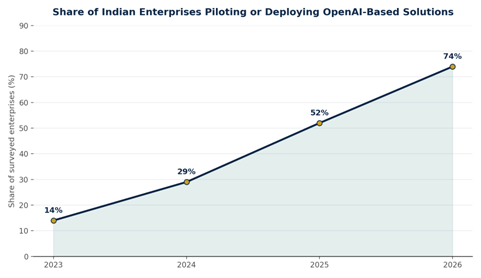
Figure 2: Indicative enterprise AI adoption trend in India, illustrating the pace of pilot and production activity since 2023.
OpenAI Consulting Partner in India vs OpenAI Implementation Partner in India

The terms consulting partner and implementation partner are often used loosely, but they describe genuinely different engagement models, and understanding the difference changes what you should ask for.
An OpenAI consulting partner in India typically leads with strategy: defining the right use cases, building the business case, assessing feasibility, and designing the target architecture before any code is written. This is valuable when a business is not yet certain which AI initiative deserves investment, or needs a vendor-neutral voice to validate an idea before committing budget. An OpenAI implementation partner in India, by contrast, is oriented around execution: building, integrating, testing, and deploying the actual system once the direction has already been set.
In practice, the sharpest version of this distinction is increasingly less useful, because most businesses do not actually need to choose one over the other. They need a partner capable of doing both under a single, continuous engagement, moving from a short discovery phase straight into build without the delay and knowledge loss that comes from handing a project between two separate vendors. That hybrid model removes two real risks at once: the platform lock-in risk of jumping straight into a partner-only build without independent validation of the use case, and the stalled-momentum risk of a consulting engagement that produces a strategy document but no working system.
Dimension | OpenAI Consulting Partner | OpenAI Implementation Partner |
Primary focus | Strategy, feasibility, use case selection | Build, integrate, test, deploy |
Typical starting point | Business case is not yet defined | Direction and architecture are set |
Core deliverable | Roadmap, architecture, business case | Working, production-grade system |
Best suited for | Early-stage evaluation and validation | Confirmed initiatives ready to build |
Risk if used alone | Stalled momentum, no working system | Platform lock-in without validation |
Red Flags to Watch for While Evaluating an AI Implementation Partner in India
A few warning signs tend to recur across engagements that go wrong, and they are worth naming directly.
• Promising a fully custom AI system on an unrealistically short timeline without asking detailed questions about your existing systems and data first.
• Vague or evasive answers about data handling, or an inability to explain clearly where customer information goes once it reaches the model.
• Pricing that sits well below the rest of the market, which is often a signal of inexperience rather than efficiency.
• A sales process where the people making the pitch are never the people who will actually do the delivery work.
What an Enterprise AI Partner in India Should Additionally Bring to the Table
Larger organisations evaluating an enterprise AI partner in India should apply everything above, plus a few additional considerations that matter more at scale. Enterprise deployments typically touch multiple business units simultaneously, so a partner needs demonstrated experience managing multi-stakeholder rollouts, not just a single well-defined pilot. Enterprise procurement also frequently requires formal security assessments, vendor risk reviews, and detailed SLAs, so ask early whether a prospective partner has been through this kind of process before with a comparable organisation. Finally, enterprise AI initiatives tend to evolve over years rather than months, so evaluate whether the partner has the bench depth to sustain a multi-year relationship rather than a team built around a single project.
AI Solutions for Businesses in India: Where OpenAI Partners Deliver the Most Value
Across the deployments Indian businesses are currently pursuing, a handful of use cases consistently deliver the clearest return.
Customer Support and Service Automation
AI-powered support, from triage and first-response drafting to fully automated resolution for common queries, remains the most common entry point for Indian businesses, largely because the return on investment is easiest to measure through ticket volume, resolution time, and customer satisfaction scores.
Content, Marketing and SEO Operations
Marketing and content teams are increasingly using OpenAI-powered tooling to accelerate research, drafting, and localisation across the many geographic markets Indian businesses now serve, while keeping brand voice and factual accuracy under human review.
Internal Knowledge and Document Intelligence
Large organisations sit on years of internal documentation that employees struggle to search effectively. AI systems that can answer questions grounded in a company's own knowledge base, rather than generic internet knowledge, have become one of the fastest-growing categories of enterprise AI deployment in India.
Workflow and Process Automation with AI Agents
The most advanced deployments now go beyond answering questions and into taking action: AI agents that can plan, execute, and complete multi-step business tasks with limited human intervention, from data entry and reconciliation to structured research and reporting workflows.
Questions to Ask Before You Sign With an OpenAI Partner in India
Before finalising any engagement, put these questions directly to the prospective partner and pay close attention to how specifically they answer:
• How many production OpenAI deployments has your team shipped, and can you share verifiable references?
• Which individuals on the delivery team hold current OpenAI certifications, and what is their direct experience?
• How exactly will our data be handled, stored, and secured at every stage of the deployment?
• What does the pricing model look like as usage scales, and what happens if the project exceeds its original scope?
• What does support and maintenance look like after go-live, and who is accountable if performance issues arise?
• Do you work across multiple model providers, or are we locked into a single vendor relationship?
• Can you point to a deployment in our specific industry, and if not, how will you close that experience gap?
Why Pearl Organisation Is a Trusted OpenAI Partner in India

Pearl Organisation is a global IT and digital business transformation company operating across more than 150 countries, and its approach to AI partnership is built around a principle that runs through everything above: strategy and execution should be treated as one continuous engagement, not two separate vendor relationships handed off between teams.
Pearl Organisation OpenAI Solutions and AI Implementation Services
Pearl Organisation OpenAI solutions span the full lifecycle a business actually needs, from initial use case discovery and architecture design through to production deployment and ongoing support. Pearl Organisation AI implementation services are delivered by teams who work hands-on with the underlying integration, rather than routing delivery through a layer of subcontractors, which keeps institutional knowledge inside the same team from the first discovery call through to post-launch support.
Pearl Organisation AI Consulting and Enterprise AI Solutions Approach
Pearl Organisation AI consulting engagements start with a structured discovery phase to validate the business case and select the right architecture before committing to a build, ensuring that Pearl Organisation enterprise AI solutions are grounded in a genuine use case rather than technology adopted for its own sake. Pearl Organisation AI solutions are also built with model neutrality in mind, giving businesses the flexibility to choose the right underlying model for a given use case while working with a single, accountable delivery partner responsible for outcomes across the full programme. As a growing Pearl Organisation OpenAI partner practice, the team combines deep platform-specific expertise with the broader digital transformation capability the company has built across cloud, software engineering, and SEO-led growth over more than a decade of client delivery.
How Pearl Organisation's OpenAI Implementation Process Works
Every engagement follows a consistent, transparent process designed to reduce the two risks that most commonly derail AI projects: a strategy that never gets built, and a build that was never properly validated.
1 | Discovery & Feasibility Work directly with stakeholders to identify high-value use cases and assess technical and data readiness. |
2 | Architecture & Design Define the specific model, integration points, and governance framework before any production code is written. |
3 | Build & Iterate Iterative development and testing against real data rather than synthetic examples wherever possible. |
4 | Pilot & Validate A structured pilot confirms the system performs reliably before full rollout. |
5 | Deploy & Support Post-deployment monitoring, model updates, and continuous optimisation as usage grows. |
Building AI Solutions for Businesses in India That Actually Last

A final point is worth stating plainly, because it gets lost in vendor pitches: the goal of choosing an OpenAI partner in India is never the deployment itself, it is the outcome the deployment is meant to produce. A support automation system that reduces resolution time but frustrates customers with generic answers has not actually succeeded. A document intelligence tool that employees stop using after the first month because it was never trained on the right internal content has not actually succeeded, regardless of how well the initial demo performed. The businesses getting the most value from AI implementation partner in India relationships tend to share one habit: they define what success looks like in measurable terms before the project starts, and they hold the partner accountable to those numbers after launch rather than treating go-live as the finish line. A capable OpenAI implementation partner in India will welcome that accountability rather than resist it, because it is exactly how a genuinely strong delivery track record gets built in the first place.
Everything You Need to Know About OpenAI Implementation Partners in India
What does an OpenAI partner in India actually do?
An OpenAI partner in India helps businesses design, build, and deploy AI systems using OpenAI's models and APIs, typically covering everything from initial strategy and use case selection through to technical integration, testing, deployment, and ongoing support.
How is an OpenAI implementation partner different from a general AI consultant?
An implementation partner is oriented around execution: building and deploying a working system. A consultant is typically oriented around strategy and feasibility. Many businesses benefit most from a partner capable of doing both under one continuous engagement.
Does a higher OpenAI Partner Network tier guarantee better delivery quality?
Not on its own. Tier standing reflects sales performance, technical certification, and platform consumption at a company level, but it does not replace due diligence into the specific team that would actually deliver your project.
What should a business budget for an OpenAI implementation project in India?
Costs vary significantly based on scope, from a focused pilot to a full enterprise-wide deployment, and depend on integration complexity, data volume, and ongoing support requirements. A transparent partner should be able to walk through cost drivers clearly during scoping rather than offering a single fixed number upfront.
Is it safe to send business data to OpenAI's models?
Data handling depends entirely on how a deployment is architected. A qualified implementation partner should be able to explain exactly what data reaches the model, how it is logged and retained, and what configuration options exist for compliance-sensitive industries, including data residency requirements.
How long does a typical OpenAI implementation project take?
A focused pilot can often be validated within a matter of weeks, while a full enterprise deployment integrated across multiple systems typically takes several months, depending on the complexity of existing infrastructure and the scope of the rollout.
Can a business work with more than one AI partner at the same time?
Yes, though it is generally more efficient to consolidate strategy and implementation under a single accountable partner, particularly for businesses running multiple AI initiatives that need to share architecture, governance standards, and institutional knowledge.
What industries in India are adopting OpenAI solutions fastest?
Financial services, e-commerce, IT services, healthcare, and consumer internet platforms have been among the earliest and most visible adopters, though enterprise AI adoption is broadening quickly across nearly every sector.
Conclusion
The Indian market now has no shortage of firms willing to call themselves an OpenAI partner in India. What it still has a shortage of is firms that can prove it: teams with certified practitioners, documented production deployments, a clear data governance framework, and the local presence to support a system after it goes live. The ten criteria in this guide, from delivery track record and Partner Network standing through to pricing transparency and post-deployment support, are designed to separate those two groups quickly, before a business commits budget and months of internal time to the wrong relationship.
The most important shift to make going in is treating the choice of partner as a business decision, not just a technical one. An OpenAI implementation partner in India should be evaluated the same way any strategic vendor would be: on evidence, references, and accountability for outcomes, not on the strength of a pitch deck or a certification badge alone. Businesses that apply this level of scrutiny consistently end up with AI systems that actually get used, scale cleanly, and deliver a measurable return, rather than another stalled pilot. Whether the right fit turns out to be a global systems integrator, an established Indian IT services firm, or a specialised partner like Pearl Organisation that combines OpenAI implementation depth with vendor-neutral consulting discipline, the diligence described here is the same worth applying before any contract is signed.










 150+
150+
 250+
250+
 21,000+
 11,600+