
Building an AI-Powered Marketing Funnel: From Lead Generation to Customer Retention

Most marketing funnels are still built for a world that no longer exists, one where a marketer manually segments a list, schedules a drip campaign, and waits weeks to learn what worked. That approach cannot keep pace with buyers who now research, compare, and decide across a dozen touchpoints before a sales team ever hears from them. An AI-powered marketing funnel closes that gap by putting machine learning, predictive scoring, and real-time personalisation into every stage of the journey, from the first anonymous website visit to the renewal conversation years later.
This shift is not theoretical. Businesses that have adopted AI marketing automation report faster lead qualification, sharper ad spend, and measurably higher retention, because the system is constantly learning from customer behaviour rather than relying on static rules set months ago. The organisations pulling ahead are not necessarily the ones with the biggest budgets, they are the ones that have rebuilt their funnel architecture around AI-driven marketing funnel principles: continuous data feedback, automated decision-making, and personalisation at a scale no human team could sustain manually.
This guide walks through what an AI-powered marketing funnel actually looks like in practice, stage by stage, and shows how AI-powered lead generation, AI campaign optimisation, and AI-driven digital marketing techniques work together to turn strangers into customers and customers into advocates. We will also look closely at how this plays out in a fast-growing market, Colombia, where AI marketing automation adoption is accelerating quickly, and where Pearl Organisation has been helping businesses build these systems from the ground up.
What Is an AI-Powered Marketing Funnel?
An AI-powered marketing funnel is a customer acquisition and retention system in which artificial intelligence actively manages decisions at every stage, who to target, what message to show, when to send it, and how to respond to behaviour in real time, instead of simply reporting on results after the fact. It still follows the familiar shape of awareness, interest, consideration, conversion, and loyalty, but each stage is now powered by models that learn continuously from data rather than fixed rules a marketer configured once and rarely revisits.
How an AI-Driven Marketing Funnel Differs from a Traditional One
A traditional funnel is largely static: audiences are built from demographic assumptions, email sequences fire on a fixed schedule regardless of engagement, and reporting happens weeks after a campaign has already run its course. An AI-driven marketing funnel behaves differently at every one of those points. Audiences are built and refined continuously from behavioural signals. Messaging adapts to what an individual prospect has actually done, not what a persona is assumed to do. And optimisation happens inside the campaign, not after it, because the system is scoring performance in near real time and reallocating budget or creative accordingly.
The practical difference shows up in speed and precision. Where a traditional team might review campaign performance monthly and adjust targeting manually, AI digital marketing systems can shift bidding, refresh ad creative, or re-sequence an email nurture flow within hours of detecting a change in response rates. That compounding responsiveness is what separates funnels that plateau from funnels that keep improving quarter over quarter.
The Core Components of an AI Marketing Automation Stack
A functioning AI marketing automation stack generally includes five layers working together. A unified customer data platform collects behavioural, transactional, and engagement data into one profile per contact, because AI is only as good as the data it can see. A predictive scoring engine ranks leads and customers by likelihood to convert, churn, or upsell. A personalisation and content layer generates or selects the right message for each segment or individual. An orchestration layer decides the next-best-action across channels, email, ads, chat, SMS, so a prospect never receives conflicting or redundant messaging. And an analytics layer feeds outcomes back into the models so they keep improving.
None of these layers needs to be built from scratch, most businesses assemble them from a mix of CRM, ad platform, and specialised AI marketing automation tools, but they do need to be connected. A brilliant predictive model with no orchestration layer just produces insights nobody acts on in time, which is one of the most common reasons AI digital marketing initiatives underdeliver on their early promise.
The Anatomy of an AI-Powered Marketing Funnel, Stage by Stage

The clearest way to understand an AI-powered marketing funnel is to walk through it stage by stage, because AI plays a distinct role at each point, and the mistake many businesses make is deploying AI in only one stage, usually advertising, while leaving the rest of the funnel running on old logic.
Top of Funnel — AI-Powered Lead Generation That Finds Real Buyers
AI-powered lead generation begins before a prospect ever fills out a form. Predictive audience models analyse existing customer data to identify look-alike segments most likely to convert, then platforms like Google Performance Max and Meta Advantage+ use those signals to find and bid on high-intent prospects automatically, adjusting creative and placement in real time rather than waiting for a human to review performance reports. On owned channels, AI-generated content, blog posts, landing pages, and ad variations tailored to specific search intent, captures organic and paid demand simultaneously.
The result is a top of funnel that fills itself with better-fit leads rather than more leads. Lead scoring models start working the moment a contact is captured, flagging which new leads deserve immediate sales follow-up and which need further nurturing, so sales teams spend their limited time on the prospects statistically most likely to close.
Middle of Funnel — AI Digital Marketing for Nurturing and Trust
Once a lead is in the system, AI digital marketing takes over the job of building trust and educating the buyer without manual intervention for every contact. Behavioural triggers, a pricing page visit, a webinar registration, a specific email click, automatically move a lead into a tailored nurture track, and the content within that track adapts based on what the prospect engages with next. A lead who downloads a technical whitepaper receives deeper technical content; one who watches a customer story receives more social proof.
Chatbots and conversational AI now handle a meaningful share of this stage too, answering product questions instantly at any hour and qualifying interest before a human sales conversation is scheduled. This is where automated digital marketing earns its value most clearly: prospects get faster, more relevant answers, and marketing teams stop manually building one-off nurture sequences for every segment variation.
Bottom of Funnel — AI Campaign Optimisation for Higher Conversions
At the bottom of the funnel, AI campaign optimisation shifts from finding and educating leads to converting them efficiently. Dynamic pricing tests, personalised offers, and predictive lead scoring all combine to focus sales effort on the accounts most likely to close in the current cycle, while AI-driven retargeting keeps warm prospects engaged with messaging calibrated to their specific objections or hesitation points rather than generic reminder ads.
This is also where the compounding effect of AI campaign optimisation becomes visible in the numbers. Because bidding, creative rotation, and audience refinement are happening continuously rather than in scheduled reviews, cost per acquisition tends to fall over time even as competition for the same keywords or audiences increases, the system is simply reacting faster than a manual process ever could.
Post-Purchase — Retention and Lifetime Value with AI
The funnel does not end at the sale, and this is the stage most businesses under-invest in even though it is often the highest-leverage one. AI-driven retention models analyse usage patterns, support interactions, and engagement trends to flag early signs of churn risk, a drop in product usage, a missed renewal touchpoint, a spike in support tickets, well before a customer decides to leave. That early warning allows a proactive outreach, a tailored retention offer, or a check-in call at exactly the right moment.
On the growth side, the same predictive layer identifies customers with high propensity for upsell or cross-sell based on usage patterns similar to existing high-value accounts, turning retention from a defensive function into a genuine revenue driver. Businesses that connect their AI-powered marketing funnel through to this post-purchase stage consistently see it outperform acquisition-only optimisation in terms of return on marketing investment, simply because retaining and expanding an existing customer costs a fraction of acquiring a new one.
AI Marketing Automation vs Traditional Digital Marketing Automation
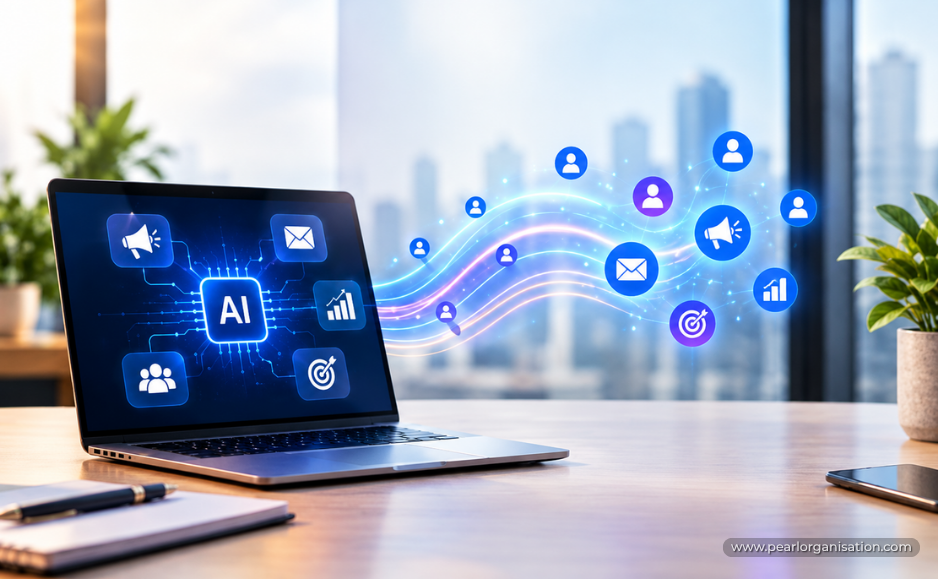
It is worth being precise about how AI marketing automation differs from the digital marketing automation most businesses already have in place. Conventional marketing automation platforms are rules-based: if a contact does X, send email Y. They are enormously useful for consistency and scale, but the logic inside them is written by a person and stays fixed until someone updates it. AI marketing automation adds a learning layer on top, the system observes outcomes and adjusts the rules itself, testing variations, reweighting audience segments, and improving targeting without waiting for a quarterly campaign review.
The two are not competitors; digital marketing automation infrastructure is usually the foundation AI marketing automation is built on. The practical upgrade path for most businesses is not ripping out existing automation tools, but layering predictive scoring, generative personalisation, and AI-driven optimisation on top of the automation and CRM systems already in place, so every future campaign gets smarter than the last one instead of repeating it.
Building Blocks of Automated Digital Marketing
Turning these concepts into a working system depends on three building blocks: the data underneath it, the channels it operates across, and the optimisation engine that ties performance back into decision-making.
Data Infrastructure and First-Party Data
Every AI-powered marketing funnel lives or dies on the quality of its underlying data. With third-party cookies disappearing and privacy regulation tightening across most markets, first-party data, collected directly through email sign-ups, account creation, CRM records, and on-site behaviour, has become the primary fuel for personalisation and predictive scoring. Businesses that consolidate this data into a single customer view, rather than leaving it scattered across separate ad platforms, email tools, and spreadsheets, get materially better results from every AI layer built on top of it.
This is also the stage where server-side tracking and CRM-to-ad-platform integration matter more than most marketing teams initially expect. Without that connective tissue, an AI campaign optimisation engine is working with an incomplete picture of what actually drove a conversion, which quietly caps how much the system can improve no matter how sophisticated the model behind it is.
AI-Driven Digital Marketing Channels — Search, Social, Email, WhatsApp
AI-driven digital marketing now touches nearly every channel a funnel depends on. Search advertising has moved almost entirely to AI-managed bidding, with platforms optimising for conversions rather than clicks. Social advertising uses similar automated bidding alongside AI-generated creative variations tested at a scale no human team could manage manually. Email marketing platforms use send-time optimisation and subject-line generation to lift open and click rates automatically. And conversational channels, website chat and messaging apps such as WhatsApp Business, which has become central to customer communication in several Latin American markets, now use AI to qualify leads and answer routine questions around the clock.
The businesses getting the most value from this shift are not necessarily using the most channels; they are using AI consistently across the channels they already run, so signals from one, say, an ad click, inform decisions in another, like which nurture sequence an email platform triggers next.
Predictive Analytics and Campaign Optimisation Engines
Predictive analytics is the engine that makes real-time AI campaign optimisation possible. Rather than reporting what happened last month, these models forecast what is likely to happen next, which leads will convert, which customers will churn, which creative variant will outperform the rest, and feed that forecast directly back into campaign decisions. This is the difference between a dashboard that describes the past and a system that actively improves the future.
In practice, this shows up as continuously improving return on ad spend, because budget is reallocated toward what the model predicts will perform best before a human would have noticed the trend manually. It is one of the clearest, most measurable returns on investing in AI digital marketing infrastructure, and it compounds the longer the models are allowed to keep learning from live data.
AI-Powered Digital Marketing in Colombia — A Market on the Rise
Nowhere is this shift more visible right now than in Colombia, where digital marketing has moved from early AI experimentation to mainstream adoption in a remarkably short window. Google commands the overwhelming majority of search market share in the country, and AI-managed bidding tools such as Performance Max and Meta Advantage+ have gone from pilot projects to standard practice among mid-sized Colombian businesses across finance, real estate, healthcare, and education.
Why AI Marketing Automation Colombia Adoption Is Accelerating
Several forces are driving AI marketing automation in Colombia adoption at once. Tightening data privacy regulation, modelled closely on the EU framework, is pushing businesses toward first-party data strategies and away from reliance on third-party tracking, exactly the shift that makes AI-driven personalisation more valuable, not less. Generative engine optimisation is also emerging quickly as Colombian consumers increasingly research products and services through AI assistants rather than traditional search alone, meaning content strategy now has to account for how AI tools summarise and recommend brands, not just how search engines rank pages.
Cost is a factor too. AI tools for content generation, image creation, and campaign management are now accessible at price points that work for small and mid-sized Colombian businesses, not just large enterprises, which has widened adoption well beyond the handful of companies that could previously afford dedicated data science teams.
AI-Powered Lead Generation in Colombia — What's Working Now
AI-powered lead generation in Colombia campaigns increasingly combine three elements: AI-managed paid search and social bidding to capture high-intent demand, WhatsApp Business chatbots to qualify and respond to inbound interest instantly, and predictive lead scoring to route the resulting leads to the right follow-up track. This combination matters in Colombia specifically because WhatsApp functions as a primary business communication channel for a large share of consumers, so a lead generation strategy that does not account for it is leaving a major intake channel unmanaged.
Businesses running these systems report substantially more efficient cost per acquisition than manually managed campaigns, largely because AI bidding continuously reallocates spend toward the audiences and placements converting best, rather than waiting for a scheduled campaign review to make that call.
Choosing Digital Marketing Services Colombia Businesses Can Trust
Not every provider offering digital marketing services Colombia businesses can hire is equipped to deliver on the AI side of that promise. The strongest partners combine three things: genuine technical depth in AI marketing automation rather than surface-level use of off-the-shelf ad platform features, fluency in the Colombian market and Spanish-language content and communication, and the ability to integrate CRM, ad platforms, and analytics into one connected system rather than running channels in isolation.
Businesses evaluating digital marketing services Colombia providers should look past headline case studies and ask specifically how a prospective partner handles first-party data collection, what predictive or AI-driven optimisation is actually running under the hood, and how retention, not just acquisition, factors into their approach.
AI Marketing Funnel Solutions in Colombia Businesses Should Demand from a Partner
When evaluating AI marketing funnel solutions in Colombia businesses should prioritise a small set of non-negotiables. The solution should unify data across the full funnel rather than optimising channels in isolation, since disconnected AI campaign optimisation in one channel while the rest of the funnel runs on old logic produces uneven, hard-to-scale results. It should support both English and Spanish-language content and communication at a native level, not a machine-translated afterthought. It should include predictive retention modelling, not just acquisition tooling, since the highest-value gains often come from the post-sale stage of the funnel. And it should be backed by a team that understands both the technical AI marketing automation stack and the specific dynamics of the Colombian market, regulatory, cultural, and channel preferences alike, because a technically sound system built on assumptions from a different market will underperform even with strong underlying models.
How Pearl Organisation Builds AI-Powered Marketing Funnels Worldwide and in Colombia

Pearl Organisation approaches the AI-powered marketing funnel as a single connected system rather than a set of separate campaigns, which is the distinction that tends to separate funnels that compound in performance from ones that plateau after an initial improvement. Operating across more than 150 countries as a global IT and digital business transformation partner, Pearl Organisation brings together the data engineering, AI implementation, and digital marketing expertise needed to build a funnel where lead generation, nurturing, conversion, and retention all draw on the same customer data foundation and the same predictive models, rather than five different tools that never talk to each other.
That combination matters specifically in a market like Colombia, where the businesses seeing the strongest results are the ones pairing genuine AI marketing automation capability with fluency in local platforms, language, and buying behaviour. Pearl Organisation's work spans exactly that intersection: building the underlying data infrastructure and AI-driven digital marketing systems that global enterprises rely on, while adapting execution, content, channels, and campaign strategy, to the specific market a client is operating in, Colombia included.
For a business trying to decide whether to build this capability in-house or bring in a partner, the more relevant question is usually not build-versus-buy but how quickly a properly connected AI-powered marketing funnel can start compounding results. Pearl Organisation's role is to shorten that runway, architecting the data and automation foundation correctly the first time, rather than layering AI tools onto a fragmented existing setup and hoping they align.
Step-by-Step: Implementing Your AI-Driven Marketing Funnel
Building this system does not require replacing everything at once. Most businesses that succeed follow a similar five-step sequence.
Step 1 — Audit and Map Your Existing Funnel
Start by auditing the existing funnel end to end, every channel, every handoff between marketing and sales, and every point where data currently sits in a disconnected tool. This audit typically surfaces the biggest blocker to AI marketing automation before any new tool is even selected: fragmented data that no predictive model can use effectively until it is consolidated.
Step 2 — Select the Right AI Marketing Automation Stack
Select an AI marketing automation stack based on the gaps that audit reveals, rather than the most feature-rich platform on the market. A business missing predictive lead scoring needs a different next investment than one that already scores leads well but lacks retention modelling, and buying tools in the wrong order wastes both budget and the data history those tools need to start learning effectively.
Step 3 — Launch AI-Powered Lead Generation Campaigns
Launch AI-powered lead generation campaigns on the channels where the target audience already spends attention, using AI-managed bidding and dynamic creative from day one rather than starting manual and adding AI later. Early campaign data becomes training data for every subsequent optimisation, so starting with AI already active shortens the time it takes the system to reach strong performance.
Step 4 — Run Continuous AI Campaign Optimisation
Treat AI campaign optimisation as continuous, not a one-time setup step. The value of these systems comes from ongoing learning, which means resisting the urge to intervene manually every time performance dips slightly, most AI-managed campaigns need a stabilisation window before the model has enough data to optimise reliably.
Step 5 — Build Retention Loops with Predictive AI
Extend the same predictive infrastructure into retention from the outset rather than treating it as a separate, later initiative. Churn and upsell models depend on the same unified customer data used earlier in the funnel, so building retention logic into the initial architecture, rather than bolting it on after acquisition systems are already live, saves significant rework.
Common Challenges in AI Digital Marketing Adoption (and How to Solve Them)
Three challenges come up consistently when businesses adopt AI digital marketing at scale. The first is data fragmentation: AI models underperform when customer data is split across disconnected tools, and the fix is almost always integration work before any new AI feature is added, not after. The second is over-automation without oversight, letting AI systems run entirely unsupervised can drift away from brand voice or miss context a human would immediately catch, so the strongest implementations keep a clear human review layer over AI-generated content and high-stakes decisions rather than removing people from the loop entirely.
The third challenge is patience. Predictive and AI-driven marketing funnel systems typically need a meaningful volume of data before their recommendations become reliably better than a well-run manual process, and businesses that abandon AI campaign optimisation after a few underwhelming weeks often do so right before the system would have started outperforming. Setting a realistic evaluation window, generally a full quarter rather than a few weeks, avoids this false-negative trap.
Measuring Success: KPIs for an AI-Powered Marketing Funnel

Measuring an AI-powered marketing funnel requires tracking metrics at each stage rather than a single top-line number. At the top of the funnel, cost per qualified lead and lead-to-opportunity conversion rate show whether AI-powered lead generation is finding better-fit prospects, not just more of them. In the middle, engagement scores and nurture-to-sales-qualified conversion rate reveal whether AI digital marketing content is actually building trust rather than just filling inboxes. At the bottom, cost per acquisition and win rate against AI-flagged high-intent leads test whether AI campaign optimisation is translating into closed revenue.
On the retention side, churn rate against AI-predicted risk scores and expansion revenue from AI-flagged upsell opportunities show whether the funnel is compounding value after the initial sale. Tracking these metrics stage by stage, rather than relying only on blended overall conversion rate, makes it possible to see exactly where an AI-driven marketing funnel is delivering value and where further investment is actually needed.
Future Trends in AI-Driven Marketing Funnels
Several trends will shape how AI-powered marketing funnels evolve over the next few years. Generative engine optimisation, making sure a brand is represented accurately when AI assistants like ChatGPT, Claude, and Perplexity summarise or recommend products, is becoming as important as traditional search visibility, particularly as a growing share of research now happens inside those tools rather than a search results page. Agentic AI, where systems don't just recommend an action but execute multi-step campaigns autonomously within guardrails a team sets, is moving from experimental to mainstream faster than most marketing leaders expected.
Hyper-personalisation will also keep deepening, moving from segment-level messaging to genuinely individual content generated in real time based on a single customer's behaviour. And first-party data strategy will keep gaining importance as privacy regulation tightens across more markets, making the businesses that invested early in clean, consolidated customer data the ones best positioned to keep improving their AI marketing automation as the underlying models get more capable.
Understanding AI-Powered Marketing Funnels and Automation
What is the difference between an AI-powered marketing funnel and regular marketing automation?
Regular digital marketing automation follows fixed rules a person configured. An AI-powered marketing funnel adds a learning layer that adjusts targeting, content, and bidding continuously based on live performance data, rather than waiting for someone to manually update the rules.
How long does it take to see results from AI marketing automation?
Most predictive and optimisation models need a meaningful data volume before recommendations outperform a well-run manual process, typically a full quarter. Basic automation gains, like faster lead response, appear almost immediately; deeper predictive gains build over subsequent months.
Is AI-powered lead generation Colombia-specific, or does the same approach work everywhere?
The underlying AI marketing automation principles are consistent globally, but execution needs to reflect local channel preferences and language. In Colombia specifically, WhatsApp Business integration and Spanish-language content are essential parts of an effective AI-powered lead generation strategy.
Do we need to replace our existing marketing tools to adopt AI digital marketing? Usually not. Most businesses layer predictive scoring, generative personalisation, and AI-driven optimisation on top of their existing CRM and automation tools rather than replacing them outright.
What is the biggest mistake businesses make when building an AI-driven marketing funnel?
Applying AI to a single stage, usually paid advertising, while leaving lead nurturing and retention on old, disconnected logic. The largest gains come from connecting AI across the entire funnel, not concentrating it in one channel.
Conclusion — Partner with Pearl Organisation
An AI-powered marketing funnel is not a single tool or campaign; it is a connected system where AI-powered lead generation, AI digital marketing content, AI campaign optimisation, and predictive retention modelling all draw on the same customer data and keep improving together. Businesses that build it that way consistently outperform those applying AI in isolated pockets, because the compounding effect only shows up when every stage is learning from the same source of truth.
Whether the goal is scaling AI marketing automation across a global operation or building AI-powered digital marketing in Colombia campaigns that reflect local buying behaviour and channels like WhatsApp, the fundamentals are the same: unify the data, connect the stages, and give the system time to learn. Pearl Organisation works with businesses at every point in that journey, from the first data audit through to a fully connected, self-optimising AI-driven marketing funnel, bringing the same global AI and digital transformation expertise to markets from Colombia to Kenya to Jordan. If your funnel is still running on last year's rules, the businesses gaining ground on you are probably not working harder. They are working with a funnel that learns.











 150+
150+
 250+
250+
 21,000+
 11,600+