
How AI Agents Can Automate Complex Business Workflows
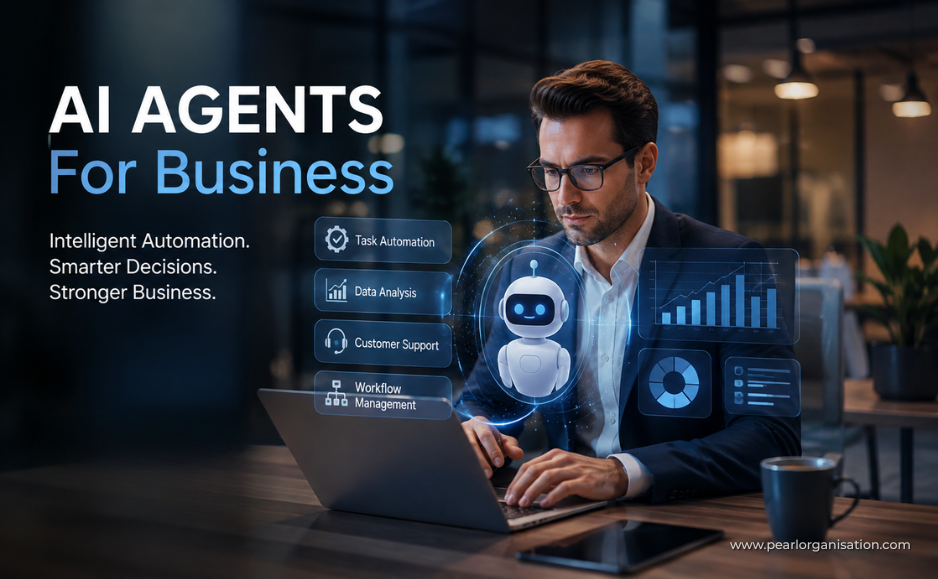
Every business eventually hits the same wall: growth creates complexity, and complexity creates friction. Orders stall between systems, approvals sit in someone's inbox for days, and customer requests bounce between departments that don't talk to each other. For years, the answer was more software, another dashboard, another integration, another rule engine. It helped, but it never quite closed the gap, because rule-based tools can only do what they were explicitly told to do.
That is exactly the problem AI agents for business were built to solve. Rather than following a fixed script, an AI agent can read a situation, decide what needs to happen next, and carry a task through multiple systems with minimal human supervision. It is the difference between a tool that moves data and a system that gets work done.
This guide breaks down how AI agents automate complex business workflows in practical terms: what they are, how agentic AI solutions differ from traditional automation, where enterprise AI agents create the most value, and how a business, including businesses in Highland, can move from pilot to production with the right AI integration services for businesses. Throughout, we'll draw on how Pearl Organisation approaches AI agent development services for clients navigating this shift.
None of this is theoretical anymore. Across industries, teams are quietly replacing brittle, rule-heavy pipelines with agents that can absorb ambiguity, make bounded decisions, and keep a process moving even when the input doesn't look exactly like the last thousand cases. The businesses getting the most value aren't necessarily the ones with the biggest budgets, they're the ones that picked the right workflow to start with, built the integrations properly, and treated governance as part of the design rather than something to bolt on afterwards. That's the approach this guide walks through, step by step.
What Are AI Agents? Understanding the Shift from Automation to Autonomy
An AI agent is a software system built around a large language model that can perceive context, reason about a goal, choose from a set of tools or actions, and execute multi-step tasks with limited human input. Instead of executing one predefined function, an agent can plan a sequence of steps, adjust that plan when conditions change, and hand off to a person only when it hits a genuine decision point.
That capability is what separates AI agents for business from the automation tools most companies already use. A traditional workflow tool moves information from point A to point B according to fixed logic. An AI agent can look at unstructured information, an email, a support ticket, a scanned invoice, understand its intent, and decide what should happen next, even when the exact scenario was never explicitly programmed.
AI Agents for Business vs Traditional Automation
Traditional automation (often built on RPA or basic workflow rules) is deterministic: if X happens, do Y. It is fast and reliable for narrow, repetitive tasks, but it breaks the moment an input doesn't match its expected shape, a slightly different invoice layout, an ambiguous customer request, a step that depends on judgment rather than a rule.
AI agents for business are built to operate in that grey area. They combine language understanding with the ability to call APIs, query databases, and trigger actions in other systems, which means they can absorb variability that would otherwise require a human to step in. The result isn't just faster processing, it's automation that can be trusted with judgment calls that used to require a person.
Agentic AI Solutions: Core Components Explained
Most agentic AI solutions are built from four layers working together: a reasoning engine (the underlying language model), a memory or context layer that tracks state across steps, a tool-use layer that lets the agent call APIs and internal systems, and an orchestration layer that sequences everything, applies guardrails, and decides when to escalate to a human. Understanding these layers matters because it clarifies what an agent can and cannot be trusted to do on its own, and where oversight needs to stay in the loop.
Why Complex Business Workflows Need AI-Powered Workflows
Complex workflows rarely live inside a single system. A single customer order might touch a CRM, an ERP, a payment processor, a logistics platform, and a support desk, and every handoff between those systems is a place where delays and errors creep in. This is exactly where AI-powered workflows earn their keep: agents can sit across that entire chain, watching for triggers, pulling context from each system, and moving the process forward without waiting for a person to manually bridge the gap.
Limitations of Rule-Based Automation
Rule-based tools require every exception to be anticipated in advance. In practice, that's impossible; new suppliers, new product lines, new regulations, and new customer behaviour constantly introduce cases nobody wrote a rule for. Each new exception means a developer has to go back and extend the logic, which is slow, expensive, and never quite keeps pace with a growing business.
How AI Workflow Automation Solves Multi-System Complexity
AI workflow automation replaces some of that rigid branching logic with an agent that can reason about the situation directly. Instead of maintaining hundreds of if/then rules, teams define the goal and the boundaries, and the agent figures out the path, pulling the right data, applying the right checks, and only pausing for a human when it's genuinely uncertain. That shift dramatically reduces the maintenance burden while making the workflow more resilient to change.
Enterprise AI Agents: Use Cases Across Departments

Enterprise AI agents deliver value fastest when they're pointed at workflows that are high in volume, cross multiple systems, and involve enough variability that fixed rules struggle to keep up. A few departments consistently see outsized returns.
Sales & CRM Automation
Agents can qualify inbound leads, enrich CRM records from public and internal data, draft personalised outreach, and schedule meetings, all while logging every action back into the CRM so nothing falls through the cracks between marketing and sales.
Finance & Operations
Invoice matching, purchase-order reconciliation, expense approval routing, and anomaly detection in spend data are natural fits, high-volume, rules-heavy tasks with enough edge cases that pure RPA tends to break down over time.
Customer Support
Support agents can triage tickets, resolve common requests end-to-end (refunds, account changes, order status), and escalate only the cases that genuinely need a human, cutting first-response time while keeping quality high.
HR & IT Service Management
From onboarding checklists to access provisioning and internal helpdesk tickets, agents can coordinate across HRIS, identity management, and ITSM tools to close requests that used to require several people and several days.
Key Benefits of Agentic AI Solutions for Complex Workflows

Once a workflow is genuinely suited to agentic automation, the benefits tend to show up quickly and compound over time. Four stand out consistently across deployments.
Speed and Continuous Operation
Agents don't wait for business hours, and they don't queue work behind other priorities the way a busy team member has to. A request that used to sit overnight or over a weekend can move forward the moment it arrives, which compounds into materially shorter cycle times across an entire process.
Consistency and Reduced Error Rates
Manual coordination across systems is where small errors creep in, a missed field, a skipped check, a step done out of order under time pressure. An agent applies the same logic and the same checks every time, which reduces rework and the downstream cost of catching mistakes late.
Scalability Without Linear Headcount Growth
Because agents handle volume without proportional increases in staffing, a business can absorb growth, more customers, more orders, more transactions, without the coordination overhead scaling at the same rate. That's a structurally different growth curve than one built purely on hiring.
Better Use of Human Judgment
Perhaps the most underrated benefit: when agents absorb the repetitive coordination work, the people on the team spend more of their time on the decisions that actually need human judgment, negotiation, relationship management, exceptions that genuinely require experience, rather than administrative shuffling between systems.
A Real-World Example: Order-to-Cash Automation With AI Agents
It helps to see how these pieces fit together in a concrete scenario. Consider a mid-sized distributor's order-to-cash process, a workflow that typically spans a sales order system, an inventory platform, a finance system, and a logistics partner, with several manual handoffs in between.
Without agentic automation, an order arrives, someone checks inventory availability manually, a second person confirms pricing and generates an invoice, a third coordinates shipping, and finance reconciles payment once it lands, often days later, and often with small discrepancies that require follow-up. Each handoff adds latency, and each manual step is a place where something can be missed under time pressure.
With an AI agent layered across the same systems through AI API integration, the process looks different: the agent receives the order, checks real-time inventory, applies pricing rules, generates and sends the invoice, triggers the shipping request, and flags the transaction for human review only if something falls outside normal parameters — an unusual discount, a credit hold, a shipping address that doesn't match past orders. Everything else moves straight through, typically in minutes rather than days, with a full audit trail of every action the agent took along the way.
This is a useful pattern to keep in mind when evaluating your own workflows: look for processes with high volume, multiple systems, and a small number of genuinely judgment-heavy exceptions. Those are the workflows where AI agents for business deliver the clearest, fastest-to-prove return.
Core Technologies Behind AI Agent Development Services
Building a production-grade agent is a different discipline from prompting a chatbot. Reliable AI agent development services combine several technical layers, each of which has to be right for the agent to be trustworthy in a real business environment.
LLMs, Orchestration Frameworks, and Retrieval
The reasoning core is usually a large language model, but the model alone isn't an agent. Orchestration frameworks sequence multi-step plans, manage state, and enforce guardrails, while retrieval-augmented generation grounds the agent's decisions in accurate, current company data rather than the model's general training. Skipping any of these layers is where most early agent pilots run into trouble.
AI API Integration: Connecting Agents to Your Tech Stack
An agent is only as useful as the systems it can reach. AI API integration is what turns a capable model into a working agent, connecting it to your CRM, ERP, finance systems, ticketing platform, and internal databases so it can read real data and take real actions, not just generate text about them. This is usually the most underestimated part of an agent project, and the part that determines whether it actually ships.
Custom AI Solutions for Businesses: Build vs Buy

Not every workflow needs a bespoke agent. Off-the-shelf agent platforms now cover a lot of common ground, scheduling, basic support triage, simple data entry, and they get a business moving quickly. But the workflows that actually differentiate a company, or that carry compliance weight, usually need custom AI solutions for businesses built around their specific systems, data, and risk tolerance.
When a Platform Is Enough
If the workflow is common across most companies in your industry, low-risk, and doesn't touch sensitive systems, a configurable platform is usually the faster and cheaper route to value.
When to Invest in Custom Agent Development
When a workflow is unique to how your business operates, touches regulated data, or needs deep integration with proprietary or legacy systems, custom development pays for itself, it's built around your actual constraints rather than forcing your process to fit someone else's template.
Traditional Automation vs. AI Agents for Business
Dimension | Traditional Automation (RPA) | AI Agents for Business |
Handles unstructured input | No — requires exact match to rules | Yes — interprets context and intent |
Adapts to new scenarios | No — needs manual rule updates | Yes — reasons through novel cases |
Cross-system coordination | Limited, brittle integrations | Native via AI API integration |
Maintenance burden | Grows with every exception | Lower — logic adapts within guardrails |
Best fit | Narrow, fixed, high-volume tasks | Complex, variable, multi-step workflows |
AI Integration Services for Businesses: Step-by-Step Implementation Roadmap
Successful agent rollouts follow a disciplined path rather than a single leap. Good AI integration services for businesses typically walk through five stages:
1. Discover — Map candidate workflows by volume, complexity, and risk, then estimate the effort and ROI for each before committing engineering time.
2. Design — Define the agent's scope, the systems it needs to reach, the guardrails it must respect, and the exact points where a human should stay in the loop.
3. Build & Integrate — Connect the agent to real systems through AI API integration, build the orchestration logic, and test extensively against edge cases, not just the happy path.
4. Deploy — Roll out to a limited group first, monitor closely, and gather feedback before expanding scope.
5. Scale & Govern — Extend the working pattern to adjacent workflows, train staff to work alongside the agent, and establish clear governance so performance and safety stay consistent as usage grows.
Skipping the discovery and design stages is the single most common reason agent projects stall, teams jump straight to building and end up automating the wrong workflow, or automating the right workflow without the guardrails it needed.
AI Automation Services in Highland: Local Market Context
Highland's business community spans a genuine mix of sectors, manufacturing, agriculture, professional services, retail, and a growing base of technology-driven companies, and that diversity shapes what good automation looks like locally. A one-size-fits-all platform built for a single vertical rarely fits the reality of a Highland business balancing several types of operational complexity at once.
Demand for AI workflow automation in Highland has grown alongside broader adoption across small and mid-sized companies that can no longer absorb coordination overhead by simply hiring more people. Once a business crosses roughly ten to fifteen employees, the handoffs between departments start creating delays and errors that compound with every new hire, and that is precisely the gap agentic systems are designed to close.
Why Highland Businesses Are Adopting AI Workflow Automation
Local operators are drawn to AI automation services in Highland for the same core reasons companies everywhere adopt them: faster turnaround on customer requests, fewer manual errors in finance and operations, and the ability to redeploy staff from repetitive coordination work to higher-value activity. What differs locally is the mix of systems already in place and the pace at which a business can realistically absorb change, both of which argue for a phased rollout rather than a single sweeping deployment.
Industry-Specific Opportunities in Highland
In manufacturing and logistics-heavy operations, agents can coordinate supplier communication, quality-alert routing, and maintenance dispatch, areas where a few minutes of manual coordination can cascade into hours of downtime. In professional services and retail, the highest-value opportunities tend to sit in client intake, scheduling, and back-office reconciliation, where AI solutions for businesses in Highland can absorb repetitive coordination without adding headcount.
Why This Matters Now
Businesses that map their highest-volume, cross-system workflows before building an agent consistently see faster time-to-value than those that automate opportunistically, discovery and design are not optional steps; they are the foundation of a successful rollout.
Choosing an AI Agent Development Partner in Highland
Not every development partner is equipped to take an agent from prototype to production. The gap between a convincing demo and a system that reliably runs a real business workflow is wide, and it's where most in-house attempts and inexperienced vendors fall short.
What to Look For
Look for a partner who can show real integration work, not just prompt design — across the systems you actually run, who builds in monitoring and human escalation from day one, and who treats governance and data security as part of the build rather than an afterthought. Ask how they've approached AI agent development services in Highland or comparable markets, what their AI integration services in Highland actually cover end-to-end, and what happened when an agent hit an edge case in production.
Why Pearl Organisation
Pearl Organisation combines enterprise software engineering discipline with hands-on agentic AI delivery, which means the agents we build are backed by the same integration rigor, testing, and security practices we bring to any mission-critical system, not a lightweight layer bolted onto existing tools.
About Pearl Organisation: Your Partner for AI Automation Services

Pearl Organisation is a global IT and digital business transformation company that helps organisations modernise how they build, integrate, and operate software. Our philosophy is straightforward: technology should remove friction from how a business runs, not add another layer of complexity on top of it. Across software integration, cloud-native development, DevOps, CRM, progressive web apps, and custom software development, we design systems that are built to be extended, because the workflows a business needs to automate today are rarely the ones it will need to automate in two years.
On the AI side, that philosophy translates into practical delivery: AI agent development services built around your actual systems, AI API integration that connects agents to the tools your teams already use, and custom AI solutions for businesses that respect existing compliance and security requirements rather than working around them. Whether a client needs a single high-impact agent or a broader AI automation services program spanning several departments, Pearl Organisation combines global engineering standards with the kind of hands-on, locally responsive delivery that AI integration services for businesses actually require to succeed, including AI automation services in Highland and other emerging markets where global best practice needs to meet local context.
Common Challenges & How to Overcome Them
Agent projects fail for predictable reasons, and most of them are avoidable with the right planning.
Choosing the Right Tools and Models
There is no single best model or framework for every workflow; the right choice depends on the reasoning complexity involved, latency requirements, cost per task, and how sensitive the underlying data is. Teams that pick tooling before scoping the workflow tend to end up retrofitting the wrong architecture onto a problem it was never designed to solve.
Data Quality and Access
An agent is only as good as the data it can reach. Fragmented, inconsistent, or poorly governed data undermines even a well-designed agent, so cleaning up data access is often the highest-leverage work done before an agent ever goes live.
Governance, Security, and Trust
As agents gain access to more systems, the potential blast radius of a mistake grows too. Strong guardrails, clear audit logging, scoped permissions, and defined escalation paths are not optional extras; they are what makes it safe to give an agent real authority in the first place.
Change Management
Employees need to understand what the agent does, what it doesn't do, and when to step in. Rollouts that skip this step tend to see low adoption regardless of how well the underlying technology performs.
Measuring ROI of AI Agents for Business
The clearest ROI signals for AI agents for business tend to fall into a few buckets: time saved per workflow instance, error and rework rates before and after deployment, cycle time from resolution request, and the value of staff time redeployed to higher-value work. Setting a baseline for each metric before deployment, not after, is what makes the eventual ROI conversation credible rather than anecdotal.
It's worth resisting the temptation to automate everything at once. Piloting on one or two well-scoped workflows, proving the metrics move in the right direction, and then scaling the pattern is a far more reliable path to sustained ROI than a single large rollout with no baseline to measure against.
It also helps to separate hard savings from soft ones when reporting results internally. Hard savings, hours reclaimed, error rates reduced, cycle time cut, are straightforward to quantify and defend. Soft gains, like improved employee satisfaction from removing repetitive work or faster customer response times that support retention, matter just as much but need to be tracked deliberately, or they tend to get left out of the ROI story entirely.
The Future of Agentic AI Solutions
Agentic AI solutions are moving quickly from single-purpose assistants toward coordinated multi-agent systems, where specialised agents handle different parts of a workflow and hand off to one another the way departments hand off work today. Expect deeper native integration inside core business platforms, stronger governance tooling as adoption scales, and a growing expectation that AI-powered workflows are simply how mid-sized and enterprise businesses operate, not an experimental add-on.
We're also likely to see agent capability become a baseline expectation inside the software businesses already buy, CRMs, ERPs, and ITSM platforms increasingly ship with agentic features built in, rather than requiring a separate layer bolted on top. That doesn't remove the need for custom development; it shifts it toward the workflows that are genuinely specific to a business, while commodity tasks get absorbed into the platforms themselves. Businesses that build solid integration and governance foundations now will be far better positioned to adopt each new wave of capability as it arrives, rather than starting from scratch every time the technology moves forward.
Ready to Automate Your Complex Workflows?
Pearl Organisation designs and builds AI agents around the systems your business already runs, from a single high-impact workflow to a full AI automation services program. Talk to our team about AI agent development services in Highland or wherever your business operates.
Understanding AI Agents: Deployment, Integration, Security & More
What is the difference between AI agents and traditional automation (RPA)?
Traditional RPA follows fixed rules and breaks when inputs vary from what it expects. AI agents can interpret unstructured information, reason about context, and adapt their approach, which makes them far more resilient across complex, multi-system workflows.
How long does it take to deploy an AI agent for a business workflow?
It depends on scope, but a well-defined single workflow typically moves from discovery to a limited pilot within a few weeks, with broader rollout following once the metrics validate the approach.
Do AI agents require replacing our existing software?
No. Most agent deployments work through AI API integration with your existing CRM, ERP, and other systems, rather than replacing them. The agent acts as an intelligent layer that coordinates work across tools you already use.
Are AI agents safe for finance and compliance-sensitive workflows?
They can be, when built with proper guardrails: scoped permissions, audit logging, and clear escalation to a human for decisions above a defined risk threshold. Governance should be designed in from the start, not added later.
Does Pearl Organisation offer AI automation services in Highland?
Yes. Pearl Organisation provides AI automation services in Highland and other markets, combining global engineering standards with delivery tailored to each client's local systems, industry, and compliance needs.
Conclusion
Complex business workflows rarely fail because of one broken step, they fail in the gaps between systems, the exceptions nobody wrote a rule for, and the coordination work that never scales cleanly with headcount. AI agents close exactly that gap, turning workflows that used to require constant manual oversight into processes that run themselves, with people stepping in only where judgment genuinely matters.
Whether you're exploring your first pilot or planning a broader AI automation services program, the businesses that succeed are the ones that start with a clear-eyed map of their workflows, invest in solid AI API integration, and build governance in from day one. Pearl Organisation partners with businesses, including AI solutions for businesses in Highland, to do exactly that: turning agentic AI from a promising idea into dependable, day-to-day infrastructure.







 150+
150+
 250+
250+
 21,000+
 11,600+