
How Will Android 11 Features Impact Your Mobile Application?
- Jun 16
- 18 min read

Introduction: Why Android 11 Matters for Your Application
Every major Android release is a moment of reckoning for the mobile development community. New features create opportunities. Behaviour changes impose obligations. Permission model updates require code rewrites. API additions open capabilities that were impossible in a previous release. And for developers who do not actively prepare, a new Android version can quietly degrade the experience their existing application delivers to millions of users before they even realise what has changed.
Android 11 is no exception. With over 3 billion active Android devices globally and Android commanding 72.2% of the world's mobile OS market (StatCounter, 2026), the decisions Google made in Android 11 affect more user devices than any competing mobile platform. For developers building and maintaining Android mobile applications, particularly those serving markets like Jordan, where Android adoption is dominant and the mobile-first user base is growing rapidly, understanding Android 11's impact is not optional. It is a prerequisite for building applications that perform correctly, protect user privacy, and remain compatible across the growing installed base of Android 11 and later devices.
Android 11, codenamed Android R, released on September 8, 2020, for Pixel devices, introduced one of the most significant overhauls of the Android permission model since Android 6.0 Marshmallow, alongside meaningful advances in conversation management, media controls, device connectivity, and developer tooling. Its impacts on Android 11 app development span privacy architecture, notification handling, storage access, network capability, and the build and test workflow that every Android development team uses.
Pearl Organisation is a trusted Android software development company serving businesses in Jordan and across the Middle East, delivering Android application development and Android mobile app development services built on the latest platform capabilities. This guide provides the comprehensive Android 11 changelog and impact analysis every Jordan-based development team and business owner needs.
1. Android 11 Overview: What Changed and Why It Matters
The Android 11 Changelog at a Glance
The Android 11 changelog represents a release with three clear strategic priorities: user privacy and data control, richer and more intelligent conversation experiences, and improved platform stability for developers. These priorities manifest across every major feature category in the release and are reflected in the specific API additions, behaviour changes, and permission model overhauls that define Android 11's impact on mobile application development.
Android 11 Feature Category | Key Changes | Primary Impact Area |
Privacy & Permissions | One-time permissions, auto-reset for unused apps, scoped storage enforcement, permissions dialog visibility limits | Data protection, app compliance, user trust |
Conversations | Dedicated conversation notification section, Bubbles API, improved shortcuts | Messaging apps, communication platforms, user engagement |
Media Controls | Redesigned media player in notification shade, seamless output switching, MediaSession improvements | Audio/video apps, podcast players, streaming services |
Device Connectivity | 5G network APIs, improved Wi-Fi suggestion APIs, Peer-to-Peer + Internet sharing | Network-dependent apps, streaming, real-time services |
Identity & Security | BiometricPrompt API improvements, Identity Credential API for digital IDs | Authentication flows, fintech apps, government services |
Developer Tools | ADB Incremental (10× faster installs), compatibility toggles, Kotlin nullability annotations | Build speed, testing efficiency, code quality |
Neural Networks API 1.3 | Expanded operations and controls for on-device ML inference | AI/ML features, on-device intelligence, edge computing |
Wireless Debugging | Debug over Wi-Fi without USB connection | Development workflow, remote debugging, enterprise deployment |
2. New Android 11 Features: A Deep Dive for Developers

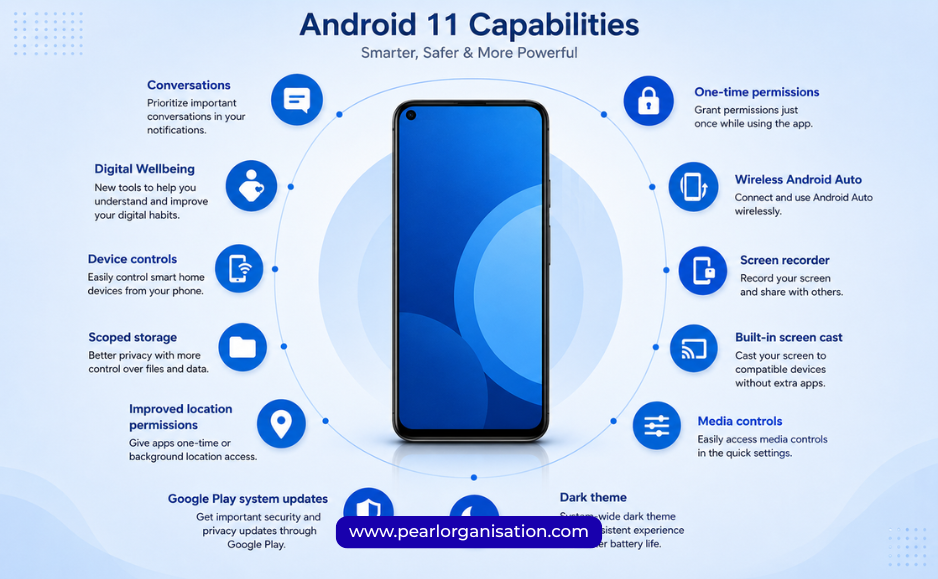
The new Android 11 features that have the most significant impact on Android mobile app development fall into six primary categories. Each requires specific developer action, whether to leverage new capability, maintain compatibility, or update existing code that depends on changed behaviour:
One-Time Permissions: The Privacy Watershed
One of the most consequential new Android 11 features for any application that requests access to sensitive device data, location, camera, or microphone is the one-time permission model. Android 11 gives users a new option when responding to a permission request: 'Only this time.' When selected, the app receives the permission for the current session only. As soon as the user leaves the app, the permission is automatically revoked. The next time the app needs the permission, it must request it again. For developers, this means that Android mobile app development logic that assumes a granted location or camera permission will persist between sessions must be updated. Applications must gracefully handle mid-session permission revocation and must not assume that a permission granted once remains available across sessions. This is particularly impactful for navigation apps, food delivery applications, camera-based services, and voice-enabled applications, all categories with significant adoption in Jordan's growing mobile market.
Auto-Reset Permissions: The Inactive App Problem
Closely related to one-time permissions is Android 11's automatic permission reset for applications that have not been used for an extended period. If an app targets Android 11 (SDK 30) and has not been opened for several months, Android 11 automatically resets all of its runtime permissions- camera, location, contacts, microphone, to their default denied state. The next time the user opens the app, they are prompted to re-grant any permissions the app requires. For Android application development teams maintaining apps with infrequent usage patterns, enterprise tools, seasonal services, and occasional utility apps, this behaviour change requires updating onboarding and permission request flows to gracefully handle re-permission scenarios without confusing users who may not understand why they are being asked to grant permissions they have granted before. Critically, auto-reset only applies to apps targeting SDK 30 on devices running Android 11. Apps targeting SDK 29 or lower running on Android 11 are not affected.
Conversations: A Dedicated Notification Space
Android 11 creates a dedicated Conversations section within the notification shade, separate from standard app notifications. This section gives messaging and communication applications WhatsApp, Telegram, SMS apps, chat platforms, and video calling tools first-class citizen status in the notification system. To appear in the Conversations section, applications must implement the MessagingStyle notification with a valid shortcut that also appears in the app's share sheet and launcher. Android 11 app development for any communication application, a rapidly growing category in Jordan's messaging-heavy mobile culture, should prioritize implementing this API to gain the visibility advantage that Conversations section placement provides. Applications that do not implement MessagingStyle correctly will continue appearing in the generic notification section, losing the prominent placement that their competitors are capturing.
Bubbles API: Floating Conversation Windows
The Bubbles API, available as an opt-in developer preview since Android 10 and now a full production API in Android 11, enables applications to display conversations as floating overlay windows that persist across other apps. Users familiar with Facebook Messenger's Chat Heads feature will immediately recognise the concept. For Android mobile application development targeting communication, customer support, or real-time collaboration use cases, Bubbles provides a powerful engagement mechanism: users can see and respond to conversations without leaving whatever app they are currently using. The implementation requires pairing with the Conversations notification system described above. For Jordan-based businesses building customer engagement apps, e-commerce support tools, or communication platforms, Bubbles represents a meaningful capability of Android 11 that can directly improve user retention and response rates.
Media Controls: Unified Player Experience
Android 11 completely redesigns how media controls are displayed. Rather than appearing as a standard notification with play/pause controls, media playback controls in Android 11 appear in a dedicated media player section near the Quick Settings panel, more prominent, more consistent, and now interactive with a seekable progress bar. Additionally, Android 11 introduces seamless media output switching: users can transfer audio playback between their phone speaker, a Bluetooth headset, a Chromecast device, and other connected audio outputs without returning to the app, directly from the media controls section. For Android mobile app development in the audio, podcast, music streaming, and video streaming categories, significant segments of consumer mobile usage in Jordan, proper MediaSession implementation is now required for correct media control display and seamless output switching behaviour.
5G Network APIs: Next-Generation Connectivity
Android 11 provides developers with significantly improved tools for detecting and responding to 5G network connectivity. The new network APIs allow applications to detect whether the user is connected to a 5G network and, importantly, whether that 5G connection is the higher-performance millimetre-wave (mmWave) variety or the more widely deployed sub-6GHz 5G. For Android application development teams building bandwidth-intensive experiences, video streaming, real-time communication, cloud gaming, live content delivery, the 5G APIs enable conditional feature activation: offering 4K streaming only when mmWave 5G is detected, or enabling high-quality video calling when sufficient network bandwidth is confirmed. Jordan is expanding its 5G infrastructure, and applications that leverage Android 11's 5G detection APIs can provide differentiated experiences as 5G adoption grows across Amman and other major urban centres.
Biometric API Improvements: Stronger Authentication
Android 11 significantly enhances the BiometricPrompt API, giving developers finer-grained control over the authentication strength required to unlock sensitive application functionality. Developers can now specify whether their application requires strong biometric authentication (fingerprint, face, iris authenticated at Class 3 strength) or will accept Class 2 (weaker) biometric authentication. This capability is critical for Android mobile app development in security-sensitive categories: banking applications, fintech platforms, healthcare record management, enterprise access management, and government service applications. For businesses in Jordan building financial services applications or e-government tools, both rapidly growing categories in Jordan's digital transformation programme, the enhanced BiometricPrompt API enables more nuanced, compliant authentication architectures. The Identity Credential API in Android 11 goes further, laying the groundwork for digital driver's licences, national IDs, and other digital identity documents, directly aligned with Jordan's national digital identity initiatives.
ADB Incremental: 10× Faster Development Builds
While end users never see ADB Incremental, it is one of the most immediately impactful capabilities of Android 11 for developer productivity. ADB Incremental enables large APK files, 2GB and above, to be installed from a development computer to an Android 11 device up to 10 times faster than conventional ADB installation. For Android game developers, augmented reality application teams, and any development team working with large-asset applications, this performance improvement directly reduces the build-test-iterate cycle time that defines development velocity. Combined with Android 11's compatibility toggles, which allow individual behaviour changes to be tested independently without a full release cycle, and improved wireless debugging over Wi-Fi, Android 11 delivers meaningful improvements to the Android application development workflow itself.
3. Android 11 Impacts: How Each Change Affects Your Existing Application
Understanding the new Android 11 features is only half of the developer challenge. The Android 11 impacts on existing applications, through mandatory behaviour changes, enforced permission model updates, and API deprecations, require systematic assessment and remediation for every app targeting or running on Android 11 devices. The following impact analysis organises these changes by the action required:
Android 11 Impact | Apps Affected | Required Action | Risk if Ignored |
One-time permission revocation | All apps requesting location, camera, or microphone | Update permission logic to handle mid-session revocation; re-request gracefully on resume | App crashes or silent failures when sensitive features are used after user leaves and returns |
Auto-reset permissions | Apps targeting SDK 30 with infrequent usage patterns | Update onboarding flows to handle re-permission; add user education for permission re-grant | User confusion when familiar app asks for permissions they previously granted |
Package visibility restrictions | Apps targeting SDK 30 that query or interact with other installed apps | Declare required package queries in AndroidManifest.xml using <queries> element | App cannot detect or interact with other installed apps; integration failures |
Scoped storage enforcement | All apps targeting SDK 30 accessing external storage | Migrate to MediaStore APIs or Storage Access Framework; remove legacy storage access | File access failures; Google Play submission rejection for apps targeting SDK 30 |
Foreground service types | Apps using camera or microphone in foreground services | Declare foreground service type (camera, microphone) in manifest; update service code | Foreground service crashes on Android 11 devices; app functionality loss |
Permission dialog limits | Apps requesting the same permission after repeated denials | Do not ask for permissions that have been denied twice; handle gracefully | Second denial triggers permanent 'Don't ask again' behaviour; permission never grantable |
MessagingStyle requirement for Conversations | Messaging and communication apps wanting Conversations section placement | Implement MessagingStyle notifications with valid sharing shortcuts | Notifications appear in generic section; reduced visibility for communication apps |
Wireless debugging requires pairing | Development teams using wireless ADB debugging | Use new pairing code flow for initial wireless connection; update deployment scripts | Development workflow disruption; CI/CD pipeline updates required |
4. Android 11 App Development Best Practices: Building for the New Standard

Targeting Android 11 Correctly
Set targetSdkVersion to 30 (Android 11) in your app's build. Gradle is the trigger for most of Android 11's opt-in behaviour changes. Google Play requires all new app submissions and all updates to existing apps to target a minimum API level, with Android 11 now part of that requirement chain. Understanding the exact set of behaviour changes that activate when targetSdkVersion is set to 30, versus changes that affect all apps running on Android 11 regardless of target, is foundational to a correct Android 11 app development migration plan.
Permission Best Practices for Android 11
Request permissions in context: ask for sensitive permissions (location, camera, microphone) only when the user is actively using the feature that requires them, not on first launch. Contextual requests achieve dramatically higher grant rates and are more resilient to the one-time permission model
Implement graceful degradation: design every feature that depends on a runtime permission to function in a reduced mode when the permission is unavailable. Applications that crash or display error screens when permissions are denied create poor user experiences and poor app store ratings
Check permissions before each sensitive operation: do not assume that a permission granted in a previous session remains granted. Android 11's one-time and auto-reset mechanisms mean that a permission check should precede every sensitive operation, not just app initialisation
Respect the 'two strikes' rule: if a user has denied a permission twice, the system permanently suppresses the permission dialog. Implement logic that detects this state and directs users to the app's Settings page to manually grant the permission if they choose.
Scoped Storage Migration Path
Scoped Storage is the most significant storage architecture change in the Android 11 changelog for apps that access external storage. The approach requires three decisions for each storage use case:
Media files (photos, videos, audio): use the MediaStore API for read and write access. Apps that create media files should use MediaStore.Images, MediaStore.Video, or MediaStore.Audio content providers. No manifest declaration is required for reading media files created by your own app
Documents and non-media files: use the Storage Access Framework (SAF) with the Android file picker. This approach gives users complete visibility and control over which files your app can access
App-specific storage: use getFilesDir() and getCacheDir() for private app files that do not need to be accessible to the user or other apps. No permission is required for app-specific storage
5. Mobile App Development Trends in Jordan: Android 11 in the Jordan Context
Jordan's Mobile-First Digital Landscape
Jordan's digital economy is experiencing rapid transformation driven by a young, tech-savvy population, high smartphone penetration, and a government committed to digital services modernisation. Mobile app development in Jordan has grown from a niche technical service to a core business capability across retail, finance, healthcare, government services, logistics, and education. Jordan is home to over 32 registered mobile app development companies (TechBehemoths, 2025), with a concentration in Amman serving both local and regional Middle Eastern markets.
The Mobile App Development Trends in Jordan that define the current landscape include: AI and machine learning integration in mobile apps; augmented reality experiences for retail, tourism, and real estate; 5G-enabled applications as Jordan's network operators expand coverage; IoT integration for smart city and smart home applications; and cloud-based app architectures that reduce device hardware dependency (Five Programmers, Medium, 2025). Android dominates Jordan's mobile OS landscape, making Android mobile application development the primary focus for businesses building consumer-facing applications in the Jordanian market.
How Android 11 Capabilities Align with Jordan's App Development Priorities
Jordan Market Priority | Relevant Android 11 Capability | Business Opportunity |
E-government and digital identity | Identity Credential API; BiometricPrompt improvements; enhanced security model | Jordan's national digital ID initiatives align directly with Android 11's digital identity infrastructure |
Financial services / FinTech | BiometricPrompt Class 3 authentication; enhanced package visibility controls | Secure, compliant banking and payment apps built on Android 11's strengthened auth model |
Messaging and communication apps | Conversations section; Bubbles API; MessagingStyle notifications | Higher engagement and visibility for Jordan's growing messaging app ecosystem |
5G-enabled services | 5G network detection APIs; mmWave vs sub-6GHz detection | As Zain Jordan, Orange Jordan, and Umniah expand 5G, apps can deliver enhanced 5G-only experiences |
Media and content streaming | Redesigned media controls; seamless output switching; low-latency video decoding | Streaming services, podcast apps, and video platforms can deliver richer playback experiences |
Enterprise and field services | Auto-reset compatible permission flows; wireless debugging; ADB Incremental | Enterprise MDM-deployed apps on Android 11 can leverage improved security and development tooling |
Gaming | ADB Incremental for large APKs; Neural Networks API 1.3 for on-device AI | Faster development cycles and on-device ML for adaptive game experiences |
6. Why Hire Android Developers in Jordan for Android 11 App Development
The Case for Local Android Expertise
For businesses operating in Jordan and across the Middle East, the decision to hire Android developers in Jordan, rather than engaging remote development teams in distant time zones, provides significant practical advantages that compound across the development lifecycle. Android 11 app development is not a set-and-forget migration: it is an ongoing process of testing, compatibility assessment, user behaviour analysis, and iterative improvement that benefits from accessible, time-zone-aligned expertise.
Jordan's Android development community has matured significantly. Clutch, TechBehemoths, and SoftwareWorld collectively list over 32 professional mobile app development companies and independent teams in Jordan as of 2025. The best Android app developers in Jordan combine deep platform knowledge with familiarity with the specific requirements of Jordanian regulatory environments, Arabic localisation, right-to-left (RTL) UI considerations, local payment gateway integrations, and the user experience expectations of Jordan's mobile-first audience.
What to Look for When You Hire Android Developers in Jordan
Android 11 and Android 12+ platform expertise: specifically, demonstrated knowledge of the permission model changes, scoped storage migration, and the new conversation and media APIs introduced in recent platform versions. Request specific examples of Android 11 compatibility work in the developer's portfolio
Google Play compliance experience: Android application development for Google Play distribution requires ongoing compliance with Play's target API level policies, privacy policy requirements, and app content policies. Developers with active Play Store experience understand these requirements without requiring client education
RTL and Arabic localisation capability: applications serving Jordanian users require full right-to-left layout support, Arabic string resources, Arabic numeral formatting, and cultural appropriateness in visual design. This is a specialised Android development skill that not all development teams possess
API integration experience relevant to Jordan: local payment gateways (eFAWATEERcom, Aramex Pay), government API integrations, and regional mapping solutions all require specific integration knowledge that Jordan-based Android developers are more likely to possess than remote alternatives
Post-launch support commitment: Android mobile application development is not complete at launch. OS updates, Google Play policy changes, user feedback, and performance monitoring all require ongoing developer engagement. Evaluate how prospective developers handle post-launch support before committing
7. Competitor Landscape: How Android 11 Content Ranks and What Jordan Competitors Miss
An analysis of the top-ranking content on Android 11 developer impact, Android 11 changelog, and mobile app development in Jordan reveals consistent patterns, and significant gaps that Pearl Organisation's Android software development company positioning can exploit:
Technical depth and specificity drive rankings, the highest-performing pieces on Android 11 features are those that go beyond feature announcements to provide specific developer action requirements. Content that explains 'how it works' and 'what you must do' consistently outperforms content that only describes 'what is new'
Impact tables are a featured snippet and AI citation magnet; structured tables mapping Android 11 changes to affected app types, required actions, and risks consistently appear in featured snippets and AI Overview citations for developer-intent queries. The format mirrors exactly how developers search for platform change information
Jordan-specific Android development content is absent from top competitors, every major competitor piece on Android 11 developer impact targets a global audience without any Jordan-specific context. The opportunity to own 'Android 11 impact for Jordan businesses', 'hire Android developers in Jordan', 'Mobile App Development Trends in Jordan', and 'Best Android App Developers in Jordan' as an integrated content cluster is completely open
Most competitor content treats Android 11 and business context separately, technical Android 11 content does not connect to business decision-making (whether to update, how to prioritise, what it costs to ignore). The integration of technical Android 11 changelog accuracy with practical business guidance represents a clear content differentiation
Arabic and RTL content gaps, Arabic-language Android 11 developer guidance is almost absent from the competitive landscape, representing an additional content opportunity for Pearl Organisation to serve Jordan's Arabic-speaking developer and business community directly
8. Pearl Organisation: Android App Development Services in Jordan
Pearl Organisation is a trusted Android software development company serving businesses in Jordan and across the region with comprehensive Android mobile app development, Android 11 compatibility migration, and end-to-end Android application development services. Our team of Android developers combines deep platform expertise with Jordanian market knowledge to deliver applications that perform correctly on Android 11 and later, comply with Google Play policies, and serve the specific requirements of Jordan's mobile-first audience.
Service | What We Deliver | Who It Serves |
Android 11 Compatibility Assessment | Full audit of existing applications against Android 11 behaviour changes, permission model requirements, scoped storage compliance, and Play Store target API level obligations | Businesses with existing Android apps needing Android 11 readiness validation before user-impacting issues occur |
Android 11 Migration & Remediation | Code updates for permission flows, scoped storage migration, MessagingStyle implementation, foreground service type declarations, and package visibility configurations | Development teams with Android 11 compatibility gaps that need systematic remediation |
Ground-up Android app development targeting Android 11+ with best-practice permission architecture, modern notification implementation, and AI-ready Neural Networks API integration | Businesses building new Android mobile applications for Jordan and regional markets | |
Android Mobile App Development (Full-Stack) | End-to-end Android mobile app development from concept through design, development, testing, Play Store submission, and post-launch support — all targeting current Android standards | Startups and enterprises across Jordan requiring a complete Android development partner |
Arabic Localisation & RTL Optimisation | Full Arabic language support, RTL layout implementation, Arabic numeral formatting, cultural UX adaptation, and bilingual content management | Applications serving Arabic-speaking users in Jordan, the wider Arab world, and diaspora markets |
Android 5G Feature Integration | Implementation of Android 11's 5G network APIs for bandwidth-adaptive features, network quality detection, and 5G-exclusive content tier delivery | Streaming, real-time communication, and media-heavy applications targeting Jordan's expanding 5G coverage |
Biometric Authentication Integration | BiometricPrompt API implementation for Class 2 and Class 3 authentication, Identity Credential API integration for digital ID use cases, and secure session management | FinTech, banking, healthcare, and government service applications requiring strong authentication |
Android App Maintenance & Support | Ongoing platform update compatibility monitoring, Google Play policy compliance, performance optimisation, and feature expansion for live Android applications | Businesses with existing Android apps requiring expert maintenance and continuous improvement |
9. Key Android 11 Updates: Features, Changelog, and Scoped Storage Explained

What are the most important new Android 11 features for app developers? The most impactful new Android 11 features for developers are: one-time permissions (users can grant location, camera, or microphone access for a single session only); automatic permission reset for unused apps targeting SDK 30; the Conversations notification section and Bubbles API for messaging applications; redesigned media controls with seamless output switching; enhanced 5G network detection APIs; improved BiometricPrompt API with authentication strength specification; the Identity Credential API for digital ID use cases; and ADB Incremental for up to 10× faster large APK installation during development. Each requires specific code changes to be leveraged correctly and to avoid compatibility failures.
How does the Android 11 changelog affect existing apps on Google Play? The Android 11 changelog affects existing Play Store apps in two ways: behaviour changes that apply to all apps running on Android 11 devices regardless of target SDK (including permission dialogue visibility limits and one-time permission support), and behaviour changes that only activate when an app targets SDK 30 (including scoped storage enforcement, package visibility restrictions, foreground service type requirements, and auto-reset permissions). Google Play now requires all new apps and all app updates to target minimum API levels that include Android 11-related requirements. Apps that have not been updated to declare a foreground service type, implement scoped storage, or handle package visibility changes will experience functionality failures on Android 11 devices.
What is scoped storage in Android 11, and why does it matter? Scoped storage is Android 11's enforcement of a partitioned storage model that replaces the broad external storage access that older apps used. Rather than reading and writing any file anywhere on external storage, apps targeting Android 11 must use specific APIs for specific data types: MediaStore APIs for photos, videos, and audio files; the Storage Access Framework for documents and non-media files; and app-specific storage directories for private data. Scoped storage is mandatory for new apps and updates targeting SDK 30 on Google Play. Apps that have not migrated away from legacy external storage access will experience permission failures and file access errors on Android 11 and later devices.
How does Android 11 impact mobile app development in Jordan specifically? For businesses in Jordan, Android 11's impacts are particularly relevant in several categories. The Identity Credential API aligns with Jordan's national digital identity programme, enabling mobile applications to participate in digital ID ecosystems. The enhanced BiometricPrompt API supports the secure authentication requirements of Jordan's growing FinTech sector. The 5G network APIs prepare applications for Jordan's expanding 5G infrastructure from Zain, Orange, and Umniah. The Conversations section and Bubbles API benefit Jordan's messaging-heavy mobile culture. And the Scoped Storage requirements affect any Jordan-built application that accesses media or documents, which includes the majority of enterprise, e-commerce, and content applications in the market.
Why should I hire Android developers in Jordan rather than remote teams? Hiring Android developers in Jordan, or engaging a Jordan-based Android software development company like Pearl Organisation, provides several advantages for businesses serving the Jordanian and regional Middle Eastern market: time-zone alignment for daily communication and sprint reviews; familiarity with Arabic localisation, RTL UI requirements, and cultural UX expectations; knowledge of local payment gateway integrations (eFAWATEERcom, Aramex Pay) and regulatory requirements; experience with Jordan-specific government API integrations; and ongoing proximity for post-launch support. Jordan's developer community is technically skilled and increasingly experienced with current Android platform standards including Android 11 and later.
How can Pearl Organisation help with Android 11 app development in Jordan? Pearl Organisation is among the best Android app developers in Jordan, providing Android 11 compatibility assessment, migration services, and end-to-end Android mobile application development for businesses across Jordan and the Middle East. Our services span Android 11 changelog remediation, scoped storage migration, permission model updates, Conversations and Bubbles API implementation, 5G feature integration, BiometricPrompt enhancement, and full Arabic RTL localisation. Every engagement begins with a structured technical assessment that identifies Android 11 impacts specific to your application before they affect your production users. Visit www.pearlorganisation.com to begin a conversation with our Android development team.
Conclusion: Android 11 Is Not Optional, It Is Your Application's New Baseline
Android 11 has moved from a platform release into the baseline reality of Android mobile application development. With Android devices commanding 72.2% of the global mobile OS market share and billions of users on Android 11 and later versions, the capabilities of Android 11 are not features that app developers can choose to engage with or ignore. They are the standard against which every Android application is evaluated by users, by Google Play, and by the platform itself when it auto-resets permissions and enforces scoped storage on non-compliant apps.
For businesses in Jordan, where Android is dominant, the mobile-first user base is growing rapidly, and digital transformation is a national strategic priority; the question is not whether Android 11 will impact your mobile application. It will. The question is whether you address those impacts proactively with expert guidance or reactively after users start experiencing failures on their updated devices.
Pearl Organisation is the Android software development company that helps Jordan's businesses navigate Android platform evolution correctly, with the technical depth to implement every Android 11 capability and compliance requirement, and the market knowledge to ensure every Android mobile application we build or migrate serves Jordan's unique user context effectively.












 150+
150+
 230+
230+
 18,000+
 10,500+