
How to Choose the Right Technology Stack for Enterprise Applications

Introduction: The Decision That Outlives the Project
Almost every other decision in enterprise application development can be revisited. A feature can be redesigned. A UI can be refreshed. A vendor can be replaced. The technology stack underneath all of it is different; it is the decision that is hardest, slowest, and most expensive to undo, and it quietly determines the ceiling on everything you try to build for years afterwards.
The scale of what's riding on this choice has only grown. The global software market reached $823.92 billion in 2025 and is projected to reach $2.25 trillion by 2034, an 11.8% compound annual growth rate driven substantially by enterprise investment in custom applications and cloud infrastructure (Precedence Research, via Keyhole Software, 2026). At the same time, 80% of enterprises are actively moving toward composable tech stacks to increase agility (Emerline, 2026), a sign that the rigid, single-vendor architectures of the past decade are being deliberately dismantled in favour of something more adaptable.
Two forces are converging to make this decision harder than it used to be. The first is architectural: the debate has moved past 'monolith versus microservices' into a more fundamental question of whether you are building a classic application or an AI-native one from the outset. The second is organisational: technology stack decisions that were once a backend IT exercise are now explicitly framed by enterprise architects as decisions that directly shape speed to market, regulatory readiness, and long-term cost efficiency, a leadership priority, not just an engineering one.
Pearl Organisation is a custom application development company helping enterprises navigate exactly this decision, translating business goals into a defensible, future-ready technology stack for enterprise applications. This guide sets out the complete framework.
1. Start With the Business Problem, Not the Framework List
The single most common mistake in technology stack selection is starting with the technology. Founders and even experienced engineering leaders get stuck comparing frameworks when the real starting question is much simpler: what are you actually trying to build, for whom, and at what scale?
This sequencing matters because the right answer changes completely depending on the goal. A team trying to launch quickly and validate market demand needs a lightweight stack that prioritises speed. A team that already knows it will scale to millions of users or handle complex regulatory data needs a stronger, more rigid enterprise-ready stack from day one, because retrofitting that rigidity later usually means a costly rebuild, not an upgrade.
The Four Questions That Should Precede Any Framework Discussion
Question | Why It Comes First | How the Answer Changes the Stack |
What are we building, and for whom? | Web apps, mobile apps, and internal tools demand fundamentally different architectures and interfaces | Consumer mobile app → React Native; internal enterprise tool → robust backend with less UI investment |
What is our product stage? | An MVP testing a new concept has entirely different requirements from a v2 platform serving thousands of daily users | Early-stage: minimise 'glue' and ship fast. Mature stage: invest in distributed data and zero-downtime infrastructure |
What does our team actually know? | A powerful stack loses all its value if your engineers cannot use it effectively without a steep learning curve | Match frameworks to real, current skills (JavaScript, .NET, Java, Python) — not aspirational plans for a team you don't have yet |
What is our risk tolerance and compliance exposure? | Banking, healthcare, and other regulated industries cannot treat technology choices as reversible experiments | High-risk, regulated sectors lean toward predictable, audited, compliance-proven stacks (.NET, Java) over bleeding-edge options |
2. The Technology Stack for Enterprise Applications: A Layer-by-Layer Framework

Once business goals and constraints are established, technology stack for enterprise applications decisions can be made layer by layer, frontend, backend and APIs, data, and cloud/DevOps, rather than as one overwhelming, simultaneous decision. You are not searching for the single 'right' stack in the abstract. You are selecting well-supported, proven tools at each layer that together serve your specific strategy.
LAYER 01 Frontend: Where Users Meet the System
React continues to dominate enterprise frontend choices because of its flexible, component-driven architecture and a virtual DOM that ensures smooth rendering even for large, data-dense applications. Its developer ecosystem and library availability make long-term maintenance considerably easier than with smaller, less-supported frameworks. For applications requiring instant SEO performance and minimal client-side JavaScript overhead, Next.js with React Server Components has become the standard upgrade path. For very large, dense corporate dashboards, the kind found in back-office enterprise tools, Angular remains a credible alternative, particularly in organisations with existing Angular expertise and strict component governance needs.
LAYER 02 Backend and APIs: The System's Powerhouse
For enterprise software development specifically, applications that need strong security and modular scaling as standard, not exceptional, requirements, Java Spring Boot, .NET Core, and Django remain the most enterprise-credible choices, each backed by mature security tooling, long support windows, and large talent pools. Where extreme concurrency or the cost of a memory-handling error is unacceptably high, Go (Golang) and Rust are increasingly chosen for high-load or safety-critical backend nodes specifically, not as full replacements for the broader stack, but as targeted tools for the highest-risk components. The architectural pattern matters as much as the language: for large-scale enterprise applications, a microservices or serverless approach is consistently recommended for the flexibility and independent scaling it provides, allowing one component to scale or be modified without destabilising the rest of the system.
LAYER 03 Data: Choosing How Information Is Stored and Retrieved
Your database layer decides how efficiently the application stores and retrieves data, and this decision should be driven by data shape, not by familiarity alone. Relational databases (PostgreSQL, MySQL) remain the right default for structured, transactional data where consistency and complex querying matter, particularly in financial or compliance-sensitive contexts. Non-relational databases (MongoDB, Firebase) suit fast-changing, less structured, high-volume data. Many enterprise applications now adopt a hybrid approach, combining both where the application genuinely handles diverse data types, such as structured user profiles alongside unstructured activity logs, rather than forcing every data type into a single model for the sake of architectural simplicity.
LAYER 04 Cloud and DevOps: The Operational Foundation
Cloud infrastructure choice should reflect workload type more than brand preference. AWS offers the broadest, most mature managed-service ecosystem and remains the default for general-purpose enterprise workloads. Google Cloud Platform has specific strengths for products with significant data or machine learning workloads, particularly where TPU-accelerated inference matters. Microsoft Azure is the natural choice for enterprise customers already embedded in Microsoft-centric organisations, and is frequently cited as the leading choice for compliance-heavy industries needing to pass GDPR, HIPAA, or financial-services audits. Containerisation via Docker is now standard practice for environment consistency; Kubernetes should be adopted only once genuine multi-service scaling complexity justifies its operational overhead, not as a default starting point for every enterprise build.
3. Scalability, Security, and AI Readiness: The Three Non-Negotiables
Once the core architecture is defined layer by layer, every technology stack for enterprise applications must be assessed against three criteria that have always mattered, and one that has only recently become equally critical.
Scalability: Designing for Growth You Haven't Hit Yet
Scalability failures most often stem from early decisions that ignored long-term demand, data complexity, or user growth at the time they were made, not from any single catastrophic technical mistake. Enterprise applications must be evaluated for both horizontal and vertical scaling options before commitment, specifically so that increased load can be accommodated without a major, costly rewrite later. For large-scale, rapidly growing enterprises, microservices architecture is consistently the better-supported path, because it allows independent components to scale without forcing the entire monolith to scale in lockstep.
Security: Non-Negotiable From the First Line of Code
Security in enterprise software development cannot be a phase that happens after the architecture is set, it has to be a property of the architecture itself. This means choosing frameworks and languages with active security update cycles, since this single factor reduces long-term risk more than almost any other stack decision. It means building in regulatory compliance (GDPR, HIPAA, sector-specific frameworks) as an architectural requirement, not a downstream feature request. And it means recognising that the choice of database, authentication library, and cloud provider all carry direct security implications that compound over the life of the application.
AI Readiness: The Newest Non-Negotiable
Scalability and security have always mattered. In 2026, AI readiness has become an equally critical layer of evaluation, not an optional add-on. 85% of developers now regularly use AI tools for coding, debugging, and code review, and McKinsey's State of AI survey found that 88% of organisations regularly use AI in at least one business function. Building software without considering AI integration in 2026 is functionally equivalent to building a web application without considering mobile in 2015, it is not a niche capability, it is the baseline expectation.
4. AI-Powered Enterprise Software: How AI Reshapes Stack Decisions

AI Has Crossed the Adoption Threshold, Faster Than Any Prior Technology Wave
Stanford HAI's AI Index Report found that generative AI use in core business functions jumped from 33% to 71% between 2023 and 2024, a doubling of adoption in twelve months. Deloitte's 2026 Software Industry Outlook projects that AI could drive productivity gains of 30% to 35% across the software development process specifically. For any enterprise still evaluating whether AI-powered enterprise software is a genuine architectural requirement or a marketing trend, the adoption curve has already answered the question.
What AI Readiness Actually Requires in a Stack
Stack Requirement | Why AI-Powered Enterprise Software Needs It | Common Implementation |
Memory and tool access for AI features | Modern AI-powered features need to do more than 'chat' — they need to solve tasks with persistent context and the ability to call external tools and systems | Vector databases, RAG architecture, agent orchestration frameworks layered onto the core application |
Hybrid language stacks | Teams increasingly run Python alongside an existing Java or .NET enterprise stack specifically for AI and ML workflows, without replacing proven core systems | Python services for AI/ML workflows; Java or .NET retained for core business logic and compliance-critical systems |
Governed AI-assisted development | AI-generated code contains measurably more vulnerabilities than human-written code, so unrestricted AI code generation is a direct security risk to the stack | Guardrails restricting AI-generated code in security-sensitive modules; mandatory peer review for all AI-assisted changes |
Clean, accessible data | AI features are only as good as the data they can reach — a stack with siloed or poorly governed data cannot support meaningful AI capability regardless of model quality | Modernised data platforms, ETL pipelines, and cloud-native data architecture treated as AI prerequisites, not separate initiatives |
Compute suited to inference workloads | Running AI inference at enterprise scale has different cost and performance characteristics than standard application compute | GPU/TPU-backed cloud compute (GCP for cost-effective inference; Azure for compliance-bound AI workloads) |
5. Enterprise Web Application Development: What Changes at Scale

Enterprise web application development introduces requirements that simply do not exist, or do not matter nearly as much, at smaller scale. Understanding these differences is essential before applying any startup-oriented stack advice to an enterprise context.
Legacy System Integration Is Usually the Real Constraint
New enterprise applications rarely get to start with a clean slate. They build upon legacy systems and existing infrastructure as their foundation, and success often depends far more on compatibility with current systems than on adopting the latest trending technology. Legacy integration requires connecting older, sometimes 20-plus-year-old systems with modern platforms while keeping core functionality intact, typically through reliable data transformation layers, standardisation on modern data formats, and, where direct integration is too risky, file-extract-based exchange as a lower-risk fallback.
Compliance Shapes the Stack, Not Just the Application
If a technology stack does not meet an enterprise's compliance requirements, it does not just create a feature gap; it actively limits the company's growth opportunities, since enterprise sales and partnership conversations routinely stall on unresolved compliance questions. Many organisations attempt to solve this with interim workarounds; genuine scalability typically requires more comprehensive modernisation rather than a series of patches layered onto a non-compliant foundation.
Talent Availability Is a Stack Decision, Not an HR Afterthought
Before finalising a stack for enterprise web application development, it is essential to check whether developers for that technology are readily available in your region or your realistic target hiring market. A rare or niche stack increases hiring costs and slows development velocity in ways that are easy to underestimate during initial architecture planning, and very expensive to discover after the team is already understaffed eighteen months into a build.
6. Total Cost of Ownership: The Number Most Stack Decisions Ignore
Organisations frequently underestimate the total cost of ownership of a technology stack decision by focusing exclusively on initial development hours while neglecting the maintenance burden that follows. This is one of the most consistent, measurable mistakes in enterprise software development planning.
The data is specific and should be treated as a planning baseline: total spend over the first three years of an enterprise application's life typically lands at two to three times the initial development cost, once maintenance, enhancements, compliance work, and operational support are properly included (Keyhole Software, 2026). Surfacing this reality early in planning, rather than discovering it mid-stream, is what prevents the budget shocks that derail otherwise successful enterprise software initiatives.
Cost Category | Commonly Underestimated By Teams | Typical Share of 3-Year TCO |
Initial development | Rarely underestimated — this is what most budgets are built around | 33–50% |
Maintenance and bug fixes | Frequently excluded from initial budget planning entirely | 20–25% |
Feature enhancements post-launch | Treated as a 'future project' rather than an inevitable continuation of the same system | 15–20% |
Compliance and security updates | Assumed to be a one-time cost rather than an ongoing operational requirement | 10–15% |
Cloud and licensing costs at scale | Modelled at launch-day usage levels rather than projected growth | 10–15% |
7. Three Real-World Stack Decision Scenarios
Abstract frameworks are useful, but technology stack for enterprise applications decisions are ultimately made in specific contexts. The following three scenarios, drawn from common enterprise patterns, illustrate how the framework above plays out in practice:
Scenario | Business Context | Recommended Stack Direction | Why |
Regulated financial platform | Banking system or high-load B2B platform where predictability, security, and reliability are the dominant criteria | Backend: Go or Rust for critical nodes. Database: distributed SQL (e.g., CockroachDB) for near-100% availability. Infrastructure: Azure for compliance and audit readiness | The cost of a single memory error or a failed compliance audit vastly outweighs the cost of slower initial development |
High-velocity SaaS/marketplace | Classic SaaS, marketplace, or creator platform prioritising speed of delivery over architectural novelty | Frontend: Next.js with Server Components. Backend: lightweight TypeScript framework on edge compute. Database: managed SQL for fast, low-overhead delivery | Minimising 'glue' work and maximising ready-made feature delivery is the dominant success factor at this stage |
Large enterprise with legacy core | Established enterprise replatforming an existing system with hundreds of engineers and existing vendor contracts | Backend: retain core Java or .NET investment. Add: Python services layered in specifically for AI/ML workloads. Architecture: phased modernisation, not a rebuild | Preserving existing institutional knowledge and contracts while incrementally adding modern AI capability reduces both cost and risk |
8. Competitor Landscape: What Top Tech Stack Content Gets Right and Misses
Reviewing the top-ranking content on technology stack for enterprise applications, enterprise application development, and related keywords in 2026 reveals consistent strengths in the competitive set, alongside clear content gaps:
Layer-by-layer structure (frontend / backend / data / cloud) is the dominant and most effective content format, pieces from Bacancy, TRooTech, and Nanobyte Technologies all converge on this structure independently, confirming it matches how readers and search engines expect this topic to be organised
'Start with business goals, not frameworks' is the most repeated, and most under-elaborated, piece of advice across competitor content. Multiple sources state this principle in a single sentence without providing the structured question framework needed to act on it, which this guide addresses directly with its four-question framework in Section 2
AI readiness coverage is inconsistent in depth, some pieces (TRooTech, Emerline) treat AI-native architecture as a primary pillar, while others (MoldStud, Technource) barely mention it despite being published in the same period. Content that integrates current, sourced AI adoption statistics (McKinsey, Stanford HAI, Deloitte) alongside the traditional scalability/security pillars achieves stronger authority signals
Total cost of ownership is acknowledged but rarely quantified, Keyhole Software's 2–3x TCO multiplier is one of the few specific, sourced figures available on this point; most competitor content discusses 'long-term cost' qualitatively without a number readers can actually budget against
Concrete decision scenarios are underused; most competitor pieces provide a generic framework without walking through specific business contexts (regulated finance vs. high-velocity SaaS vs. legacy enterprise) the way Emerline's three-scenario model does, which is the single most actionable content pattern observed in this research and is replicated in Section 8 of this guide
9. Pearl Organisation: Custom Enterprise Software Solutions
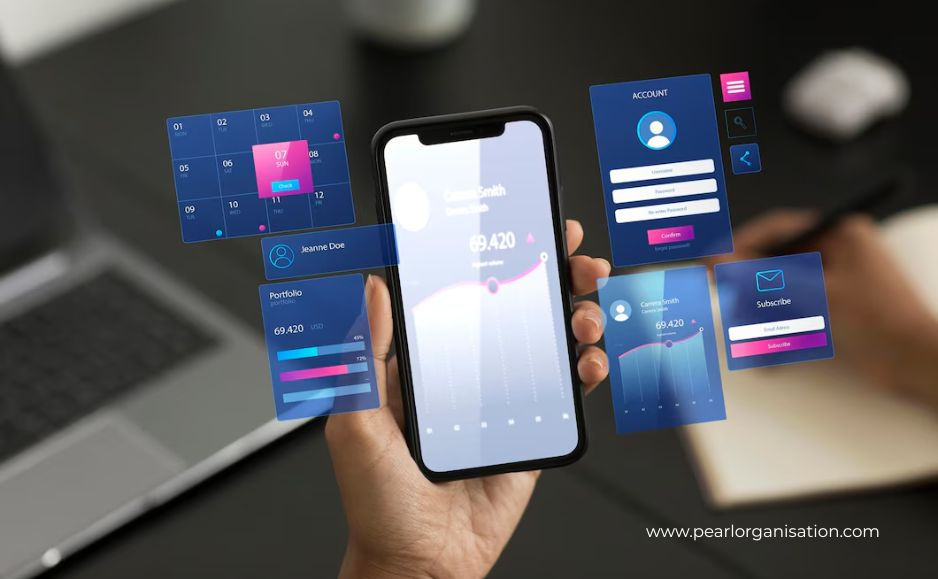
Pearl Organisation is a custom application development company helping enterprises across India and globally design, build, and modernise technology stacks for enterprise applications that are scalable, secure, and AI-ready from day one. Our enterprise application development team applies the layer-by-layer framework in this guide to every engagement, translating business goals into a defensible architecture before a single line of production code is written.
Service | What We Deliver | Business Outcome |
Technology Stack Assessment & Strategy | Structured evaluation against business goals, scalability needs, security requirements, AI readiness, and team capability, before any framework commitment | A defensible, business-aligned stack decision with documented rationale, not a default choice made by habit |
Full-stack development across frontend, backend, data, and cloud layers using Java Spring Boot, .NET Core, React, Next.js, and modern cloud-native architecture | Production-grade enterprise applications built for the scale, security, and compliance your business actually requires | |
Bespoke software purpose-built around your specific workflows, data relationships, and competitive requirements, not adapted from a generic template | Software that fits your business exactly, with full IP ownership and no vendor lock-in | |
Legacy system integration, compliance-driven architecture, and talent-availability-conscious stack selection for large-scale web platforms | Enterprise web applications that integrate cleanly with existing systems and scale without costly rewrites | |
AI-Powered Enterprise Software Integration | RAG architecture, vector database implementation, AI-assisted development governance, and hybrid Python/Java/.NET stack design for AI-native capability | AI features embedded where they deliver genuine business value, governed by the security and review standards enterprise software demands |
Legacy Modernisation & Stack Migration | Phased modernisation of existing enterprise systems, preserving institutional investment while incrementally introducing modern, AI-ready architecture | Reduced technical debt and improved AI readiness without the cost and risk of a full rebuild |
10. Building Future-Ready Enterprise Applications: Choosing the Right Tech Stack
How do I choose the right technology stack for enterprise applications? Start with your business goals, not the framework list: define what you are building, for whom, at what product stage, with what team skills, and under what compliance and risk constraints. Only after these four questions are answered should you evaluate frontend, backend, data, and cloud layers individually. A technology stack for enterprise applications should be assessed against scalability, security, and in 2026, AI readiness as three equally weighted, non-negotiable criteria, not a checklist of trending tools.
What is the difference between a startup tech stack and an enterprise software development stack? Startup stacks typically prioritise speed to market and minimal 'glue' work, favouring lightweight frameworks like Node.js or Next.js with managed infrastructure (Vercel, Railway). Enterprise software development stacks prioritise predictability, security, and long-term maintainability, typically favouring Java Spring Boot, .NET Core, or Django, often combined with microservices architecture for independent scaling. The right choice depends on product stage and risk tolerance, not on which option is more modern, a large bank or healthcare platform genuinely needs the slower-moving, more rigorously audited enterprise stack, even though it is less exciting to build with.
How does AI-powered enterprise software change technology stack decisions? AI readiness now requires specific architectural additions: vector databases and RAG architecture for AI features with memory and tool access, hybrid language stacks (commonly Python layered onto an existing Java or .NET core) to support AI/ML workloads without disrupting proven systems, governance frameworks restricting AI-generated code in security-sensitive modules, and compute infrastructure suited to AI inference workloads. With 85% of developers now regularly using AI coding tools and 88% of organisations using AI in at least one business function, AI readiness has moved from an optional enhancement to a baseline requirement for any modern tech stack for business applications.
How much does enterprise application development really cost over time? Initial development cost is typically only one-third to one-half of the true three-year cost. Total cost of ownership for enterprise software development typically lands at two to three times the initial development cost once maintenance, feature enhancements, compliance updates, and scaling infrastructure costs are included. Organisations that budget only for initial development hours, without planning for this multiplier, are the ones most likely to experience disruptive mid-project budget shocks.
Should an enterprise prioritise microservices or a monolith architecture? For large-scale, rapidly growing enterprises, microservices architecture is generally the better-supported path because it allows independent components to scale and be modified without destabilising the entire system. However, microservices introduce real operational complexity, including Kubernetes orchestration overhead, that is not justified for smaller or early-stage applications. The right answer depends on actual scale requirements and team operational maturity, not on which architecture is currently most discussed in industry content.
How can Pearl Organisation help my business choose and implement the right technology stack? Pearl Organisation, as a custom application development company, begins every enterprise application development engagement with a structured technology stack assessment, evaluating your business goals, scalability needs, compliance requirements, team capability, and AI readiness before recommending any specific frameworks or platforms. We then deliver custom enterprise software solutions and enterprise web application development built on that assessment, with full transparency on total cost of ownership from the outset. Visit www.pearlorganisation.com to begin a technology stack consultation with our team.
Conclusion: A Stack Is a Strategic Commitment, Not a Shopping List
Choosing a technology stack for enterprise applications has never been a purely technical exercise, but in 2026 the business stakes attached to that choice are higher and more visible than ever. The global software market's continued growth, the rapid normalisation of AI-powered enterprise software, and the shift toward composable, modular architecture all point to the same underlying truth: enterprises that treat stack decisions as strategic, business-aligned commitments consistently outperform those that default to familiar tools or chase whatever framework is trending.
The framework in this guide starts with business goals, evaluates layer by layer, assesses against scalability, security, and AI readiness, and budgets honestly for total cost of ownership, is not a shortcut. It is the discipline that separates enterprise software development that compounds in value from enterprise software development that quietly accumulates technical debt and constrains growth.
Pearl Organisation, as a custom application development company, applies exactly this discipline to every custom enterprise software solution and enterprise web application development engagement we deliver, helping businesses build technology foundations that serve their strategy for years, not just their next release.







 150+
150+
 250+
250+
 21,000+
 11,600+