
REST API vs GraphQL: Which Is Better for Your Application?

Introduction: The API Architecture Decision That Shapes Your Application
Every modern application is built on APIs. Whether you are building a SaaS platform, a mobile application, a microservices architecture, or an enterprise integration layer, the API design decisions you make early in development determine your system's performance, scalability, developer productivity, and long-term maintainability. And in 2026, no decision in this space is debated more intensely than REST API versus GraphQL.
The stakes are significant, and the data is striking. REST APIs power 83% of all public web services and are present in 92% of Fortune 1000 production environments (MuleSoft Connectivity Benchmark Report). Meanwhile, GraphQL enterprise adoption has surged 340% since 2023, with 67% of companies reporting improved developer productivity after adopting it (Postman State of APIs, 2024). The GraphQL tooling market has reached $890 million in 2026. Yet 93% of development teams still rely on REST for at least part of their stack.
The question is no longer which architecture is objectively better, it is which architecture is better for your specific application, your team's expertise, and your business requirements. The answer depends on a nuanced understanding of how each approach works, where each genuinely excels, and when a hybrid strategy serves better than either alone.
Pearl Organisation is a leading provider of API development services in Canada, helping startups, SaaS companies, and enterprises across Canada and globally design, build, and optimise modern API integration solutions. This guide provides the comprehensive, data-driven REST API comparison you need to make the right architectural decision for your application in 2026.
1. REST API Development: What It Is and How It Works
What Is REST?

REST, Representational State Transfer, is an architectural style for designing networked applications, introduced by Roy Fielding in his 2000 doctoral dissertation. REST APIs communicate over HTTP using a standard set of methods (GET, POST, PUT, PATCH, DELETE) to perform operations on resources identified by URLs. Each URL represents a specific resource, a user, an order, a product, and the HTTP method specifies what to do with it.
REST API development follows six guiding architectural constraints: a client-server architecture that separates concerns, stateless communication where each request contains all information needed to process it, cacheability of responses, a uniform interface through consistent URL and method conventions, a layered system that allows intermediaries like load balancers and API gateways, and optionally code-on-demand. These constraints combine to create a predictable, well-understood architecture that integrates naturally with the HTTP protocol that powers the web.
How REST API Development Works in Practice
A typical REST API for an e-commerce application might expose the following endpoints, each returning a JSON response:
HTTP Method | Endpoint | Action | Response |
GET | /api/users/123 | Fetch user profile by ID | Full user object with all fields |
GET | /api/users/123/orders | Fetch all orders for user 123 | Array of order objects |
GET | /api/products/456 | Fetch product details | Full product object |
POST | /api/orders | Create a new order | Created order object with ID |
PUT | /api/users/123 | Update user profile (full replace) | Updated user object |
PATCH | /api/users/123 | Update specific user fields | Updated user object |
DELETE | /api/orders/789 | Delete order 789 | 204 No Content |
REST API Development: Core Strengths
Simplicity and universality: REST is built on HTTP, the protocol every developer already understands. Any language, any framework, any platform can consume a REST API without specialised libraries or client-side tooling. This universality makes REST the default for public APIs and third-party integrations
Native HTTP caching: REST responses can leverage standard HTTP caching headers (Cache-Control, ETag, Last-Modified), enabling reverse proxies, CDNs, and browsers to cache responses efficiently. This dramatically reduces server load for read-heavy workloads and is one of REST's most significant performance advantages over GraphQL
Mature tooling ecosystem: decades of adoption have produced an extraordinarily rich ecosystem of tools for REST API development: API gateways, documentation generators (Swagger/OpenAPI), testing frameworks, monitoring solutions, and integration libraries are all REST-native
Predictable performance for simple operations: REST handles approximately 20,000 simple requests per second in standardised benchmarks, 33% higher throughput than GraphQL for simple CRUD operations, due to its minimal server-side processing overhead (Tech-Insider, 2026)
Stateless scalability: the stateless nature of REST makes horizontal scaling straightforward: every server handles every request independently, with no shared session state to synchronise
REST API Development: Key Limitations
Over-fetching: REST endpoints return fixed data structures, often including fields the client does not need. A mobile app requesting a user's name and email receives the entire user object, wasting bandwidth and increasing parse time
Under-fetching and the N+1 problem: when a single view requires data from multiple resources, REST requires multiple sequential API calls. A dashboard showing user details, recent orders, and product recommendations might require four or five separate HTTP requests
Versioning complexity: as APIs evolve, REST APIs accumulate multiple versions (/api/v1/, /api/v2/) that must be maintained simultaneously, increasing documentation burden and the risk of client breakage
Tight endpoint-client coupling: REST's fixed endpoint structure means that new client requirements often require new server endpoints, creating coupling between frontend evolution and backend development cycles
2. GraphQL API Development: What It Is and How It Works
What Is GraphQL?
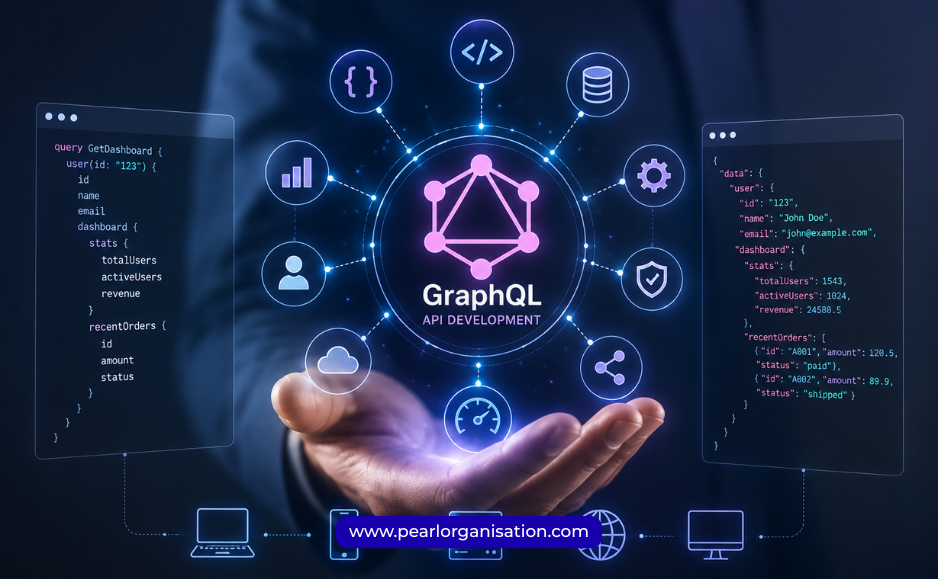
GraphQL is a query language for APIs and a runtime for executing those queries, developed by Facebook in 2012 and open-sourced in 2015. Unlike REST, which exposes multiple endpoints, one per resource, GraphQL exposes a single endpoint through which clients submit declarative queries specifying exactly the data they need. The server executes the query against a strongly-typed schema and returns precisely the requested data, nothing more, nothing less.
The GraphQL API development model works like a custom food order rather than a fixed menu. A REST API says, 'Here is the user object, take it or leave it.' A GraphQL API says 'tell me exactly which fields you need from which resources, and I will return precisely that, in a single request.
How GraphQL API Development Works in Practice
A single GraphQL query can retrieve the same data that would require four REST calls, in a single network round trip:
Data Requirement | REST Approach (4 requests) | GraphQL Approach (1 query) |
User profile (name, email) | GET /api/users/123 | Single query: { user(id: 123) { name email orders { id total } product { name price } } } |
User's recent orders | GET /api/users/123/orders | ↑ The same single query retrieves all data |
Featured product details | GET /api/products/456 | ↑ The same single query retrieves all data |
Product recommendations | GET /api/users/123/recommendations | ↑ The same single query retrieves all data |
Result | 4 network round trips; potential over-fetch on each call | 1 round trip; exactly the data specified |
GraphQL API Development: Core Strengths
Precise data fetching: clients request exactly the fields they need, eliminating both over-fetching (receiving unnecessary data) and under-fetching (requiring multiple requests). This efficiency is most valuable for mobile applications where bandwidth and battery life are constrained
Single endpoint simplicity: all queries, mutations, and subscriptions are sent to one endpoint. This simplifies routing, monitoring, and gateway configuration compared to the sprawling endpoint landscape of large REST APIs
Strong typing and introspection: GraphQL's type system is self-documenting. Clients can query the schema itself to understand available types and fields, and the compiler catches type mismatches before they reach production
No versioning required: because clients specify exactly which fields they need, server-side fields can be added without breaking existing clients. Deprecated fields can be flagged in the schema. This eliminates the /v1 /v2 versioning problem that plagues REST APIs at scale
Real-time subscriptions: GraphQL natively supports WebSocket-based subscriptions for real-time data updates, enabling live dashboards, collaboration features, and event-driven UIs without the complexity of custom webhook or polling implementations
28% lower latency for complex queries: GraphQL achieves 180ms median latency for multi-resource queries compared to REST's 250ms, a 28% advantage that compounds significantly in applications requiring complex data relationships (Tech-Insider, 2026)
GraphQL API Development: Key Limitations

Caching complexity: GraphQL's single endpoint and client-defined queries make HTTP-level caching ineffective. Caching requires client-side cache management (Apollo Client, Relay) or server-side query result caching, adding architectural complexity that REST avoids
Server-side processing overhead: GraphQL requires query parsing, validation against the schema, and resolver execution for every request, consuming 20% more CPU than equivalent REST requests for simple operations (Tech-Insider, 2026)
N+1 query problem: without careful implementation using tools like DataLoader, GraphQL resolvers can generate a separate database query for each item in a list, degrading performance significantly in data-heavy use cases
Higher learning curve: GraphQL requires developers to understand schema definition, resolver architecture, query complexity, and client-side caching tools. The investment is worthwhile for complex applications, but adds meaningful onboarding cost for teams new to it
File uploads and binary data: GraphQL was designed for structured data queries; handling file uploads and binary data requires workarounds or supplementary REST endpoints
3. REST API Comparison: Head-to-Head Against GraphQL in 2026
The definitive REST API comparison for 2026 must go beyond feature lists to address the specific technical, operational, and business dimensions that determine which architecture serves your application best:

Dimension | REST API | GraphQL |
Architecture | Multiple endpoints; one URL per resource type | Single endpoint; client-defined queries against a typed schema |
Data Fetching | Fixed response structure; over/under-fetching common at scale | Precise client-specified fields; eliminates over-fetching and N+1 round trips |
Performance: Simple Ops | ~20,000 req/sec; 250ms median; 20% less CPU than GraphQL | ~15,000 req/sec; higher CPU per request due to parsing/validation overhead |
Performance: Complex Queries | Multiple round trips required; total latency compounds per call | 180ms for multi-resource queries; 28% faster than equivalent REST chain |
HTTP Caching | Native HTTP caching via CDNs, reverse proxies, browser cache | HTTP caching ineffective; requires Apollo/Relay client or server-side cache |
Real-time Support | Polling or external WebSocket setup required | Native subscriptions via WebSocket for real-time data streams |
API Versioning | Versioned URLs (/v1, /v2); all versions maintained simultaneously | Schema evolution without versioning; deprecated fields flagged in schema |
Security | Per-endpoint auth; mature middleware ecosystem; easy rate limiting by URL | Query depth/complexity limiting required to prevent malicious queries; more complex |
Tooling Maturity | Decades of mature tools; universal language/framework support | Growing ecosystem; Apollo, Relay, Hasura; 800K+ weekly Apollo Server downloads |
Error Handling | Standard HTTP status codes (200, 400, 404, 500) natively | Always returns 200; errors in response body — requires custom error parsing |
File Uploads | Native multipart form support via HTTP | Requires workarounds (multipart spec, separate REST endpoint) |
Documentation | OpenAPI/Swagger; rich auto-generation tooling | Introspective schema is self-documenting; GraphiQL/Apollo Studio interactive |
Learning Curve | Low — built on HTTP everyone knows | Medium — schema, resolvers, type system, N+1 mitigation all require learning |
Best For | Public APIs, CRUD operations, microservices, simple data requirements | Complex data graphs, mobile apps, SaaS dashboards, rapid frontend iteration |
4. REST API vs GraphQL for SaaS Applications: What the Evidence Shows

Why the SaaS Architecture Decision Is Different
REST API vs GraphQL for SaaS applications deserves its own analysis because SaaS products have a specific set of architectural requirements that differ from standard web applications. A SaaS platform typically serves multiple client types simultaneously, web applications, mobile apps, third-party integrations, internal tooling, and partner API consumers, each with different data requirements from the same backend. This multi-client complexity is precisely where GraphQL's client-defined query model creates the strongest advantage over REST.
The adoption data reflects this. 67% of SaaS companies now use GraphQL for at least part of their API surface. 78% of mobile-first companies report improved performance with GraphQL (TechRT, 2026). E-commerce SaaS platforms: 67% use GraphQL for product catalog APIs where query flexibility matters most. Companies that have migrated data-heavy SaaS dashboards from REST to GraphQL consistently report 40–60% reductions in API call volume.
SaaS-Specific Architecture Recommendations
SaaS Component | Recommended API Architecture | Rationale |
Customer-facing dashboard / web app | GraphQL | Complex data relationships; multiple widgets requiring different data shapes; rapid UI iteration without backend changes |
Mobile application | GraphQL | Bandwidth efficiency; precise field selection reduces data transfer; single round trip for complex views |
Third-party public API | REST | Universal accessibility; simpler for external developers; mature tooling; OpenAPI documentation standard |
Microservice internal communication | REST or gRPC | Low latency, stateless; gRPC preferred for performance-critical internal services |
Real-time features (notifications, live data) | GraphQL subscriptions | Native WebSocket support; cleaner implementation than REST polling |
File upload / binary data endpoints | REST | Native HTTP multipart support; simpler than GraphQL workarounds |
Admin / internal tooling | GraphQL | Complex queries, reporting, cross-entity relationships benefit from GraphQL flexibility |
Webhook delivery / event notifications | REST | Simple HTTP POST; no schema definition needed; easy to consume by any receiver |
Real-World SaaS Adoption Benchmarks
GitHub: migrated to GraphQL for its developer API in 2016, enabling clients to request exactly the repository, issue, and pull request data they need in a single query, dramatically reducing the number of API calls required for complex developer tooling
Shopify: uses GraphQL as the primary API for its Storefront and Admin APIs, enabling 78% of e-commerce platform clients to query product catalog data more efficiently, with reduced over-fetching compared to the previous REST API
Netflix: uses GraphQL through its Federated GraphQL Platform, enabling each microservice to expose its own GraphQL schema that is composed into a single unified API for client consumption
Airbnb, Pinterest, PayPal: all running GraphQL in production for data-complex, multi-client SaaS contexts where data fetching efficiency and schema evolution without versioning create compelling advantages
5. The API Architecture Decision Framework: REST or GraphQL for Your Application
The definitive answer to 'REST API vs GraphQL' is not a technology preference — it is a structured analysis of your specific application's data requirements, team capabilities, client diversity, and operational context. The following framework guides that decision:
Decision Factor | Choose REST API Development | Choose GraphQL API Development |
Data complexity | Simple, predictable data shapes with low relationship complexity | Complex data graphs with many entity relationships and varied query patterns |
Client types | Single client type with uniform data requirements | Multiple client types (web, mobile, partners) with different data needs from the same backend |
Mobile application | Desktop-first product; bandwidth is not a primary constraint | Mobile clients are primary; bandwidth efficiency and reduced round trips are critical |
Real-time requirements | Primarily request-response; no live data streams required | Real-time data, live dashboards, and collaborative features require subscriptions |
Frontend evolution speed | Stable UI; infrequent frontend changes; backend-driven data structure | Rapid frontend iteration; frontend teams need data flexibility without backend changes |
Team expertise | REST expertise in place; GraphQL learning curve not justified by complexity | The team is GraphQL-experienced, or the application complexity justifies the learning investment |
Public/third-party API | Exposing API for external developer consumption; universality matters | Internal or partner-specific API where typed schema and productivity benefits apply |
Caching requirements | High-volume read workloads where HTTP caching reduces server load significantly | Dynamic, personalised data where caching complexity is manageable client-side |
Security model | Per-endpoint security model preferred; mature REST middleware in place | Unified schema security model acceptable; query complexity limiting will be implemented |
Performance priority | Simple CRUD throughput is primary concern; 33% REST throughput advantage applies | Complex query latency is primary concern; 28% GraphQL latency advantage applies |
6. Modern API Development in Canada: Trends and Best Practices
The Canadian API Development Landscape in 2026
Modern API development in Canada is being shaped by the same global forces driving API architecture decisions worldwide, but with specific contextual factors that Canadian businesses and development teams must account for in their API integration solutions.
Canada's technology sector is experiencing strong API adoption growth. Around 83% of businesses are using APIs to maximise returns from digital assets and connected services (TechRT, 2026). Enterprise API adoption rose from approximately 68% in 2022 to over 84% in 2023, with further increases through 2025. The Canadian tech ecosystem, anchored in Toronto, Vancouver, Montreal, and Ottawa, is home to a growing concentration of SaaS companies, FinTech platforms, healthcare technology firms, and enterprise software developers, all of whom are navigating the REST vs. GraphQL decision as their systems scale.
Canada-Specific API Development Considerations
PIPEDA and Bill C-11 compliance: Canadian API integration solutions handling personal data must comply with the Personal Information Protection and Electronic Documents Act and the emerging Bill C-11 framework. API design choices affect data minimisation: GraphQL's precise field selection provides a natural architectural advantage for data sovereignty, you only transmit the specific fields requested, which can support data minimisation principles in privacy-compliant API design
Cross-border data considerations: Canadian businesses serving US and European markets must account for data residency and cross-border transfer requirements. API architecture choices affect where and how data is processed, a consideration that Pearl Organisation's API development services in Canada address explicitly in every enterprise engagement
Bilingual application requirements: SaaS products serving Canadian markets often require French and English language support. GraphQL's flexible query model can retrieve localised content variations in a single query, while REST typically requires separate endpoints or query parameters for language-specific responses
FinTech and Open Banking APIs: Canada's growing Open Banking initiative is driving significant REST API development activity in the financial sector. Open Banking APIs are being standardised on REST due to universality and the maturity of REST-based OAuth 2.0 security standards. However, financial SaaS platforms serving those APIs internally often use GraphQL for the data-rich dashboard experiences that banking applications require
Healthcare data integration: Canadian healthcare technology companies face strict requirements under PIPEDA and provincial health data regulations. API integration solutions in Canada for healthcare contexts require careful attention to both REST and GraphQL security models, query depth limiting, field-level authorisation, and comprehensive audit logging are non-negotiable.
API Security Best Practices for 2026
REST API development: implement OAuth 2.0 with JWT for authentication; rate limiting by endpoint and by client; TLS 1.3 for all communications; OWASP API Security Top 10 compliance (Broken Object-Level Authorization, BOLA, accounts for 40% of API attacks)
GraphQL API development: implement query depth and complexity limiting to prevent denial-of-service through malicious query structures; field-level authorisation in resolvers; persisted queries for production (whitelist approved query strings); disable introspection in production if schema exposure is a security concern
For both: comprehensive API gateway implementation (AWS API Gateway, Kong, Apigee) providing unified authentication, rate limiting, monitoring, and traffic management regardless of the underlying API architecture
7. Competitor Landscape: How API Development Content Ranks in 2026
An analysis of the top-ranking content on 'REST API comparison', 'GraphQL API development', 'REST API vs GraphQL for SaaS applications', and related terms reveals consistent patterns among the highest-performing pieces, and significant gaps that Pearl Organisation's API development services in Canada can exploit:
2026 performance benchmark data is a decisive ranking signal, pieces that cite specific, sourced numbers (28% latency advantage, 340% enterprise adoption surge, 20,000 vs 15,000 requests per second) consistently outperform opinion-led comparisons. The latest quantified benchmark data from Tech-Insider, Postman, and TechRT is a primary differentiator
The head-to-head comparison table is universal, every top-ranking piece includes a structured comparison table. Pieces with more dimensions, more precise data, and clearer 'when to use each' guidance consistently achieve higher engagement metrics and AI citation rates
Canada-specific API development content is virtually absent, all major competitor pieces target a generic global audience. There is a significant and largely unclaimed opportunity for API development services in Canada positioning that addresses Canadian regulatory context (PIPEDA, Bill C-11, Open Banking), Canadian SaaS market dynamics, and the specific API integration solutions in Canada that Canadian businesses require
SaaS-specific API architecture guidance is underserved, most competitor pieces present REST vs. GraphQL as a generic choice without addressing the specific multi-client, data-rich context of SaaS application development. The REST API vs GraphQL for SaaS applications angle, with real adoption data from GitHub, Shopify, and Netflix, is a strong differentiation opportunity
Hybrid architecture guidance is the emerging frontier, the most sophisticated 2026 content positions the answer as 'both, strategically' rather than one-or-the-other. Pieces that provide specific guidance on when to use REST versus GraphQL within the same system architecture consistently achieve higher authority signals than pieces that recommend a single winner
8. Pearl Organisation: API Development Services in Canada
Pearl Organisation provides comprehensive modern API development in Canada, from REST API development and GraphQL API development to API integration solutions, API gateway architecture, and the hybrid API strategies that enterprise and SaaS applications require in 2026. Our API development services in Canada cover the full API lifecycle:
Service | What We Deliver | Business Outcome |
REST API Development | RESTful API design following OpenAPI specification, endpoint architecture, authentication (OAuth 2.0/JWT), documentation, versioning strategy, and performance optimisation | Scalable, documented, security-hardened REST APIs that integrate universally with third-party platforms and developer ecosystems |
GraphQL API Development | Schema design, resolver architecture, N+1 query mitigation via DataLoader, subscription setup, Apollo Server or Hasura implementation, query complexity limiting, client-side cache strategy | Data-efficient, schema-driven APIs that eliminate over-fetching, accelerate frontend development velocity, and reduce mobile bandwidth consumption by up to 60% |
REST API Comparison & Architecture Review | Technical assessment of existing API architecture, performance benchmarking, identification of over-fetching and under-fetching patterns, migration pathway design | Evidence-based architectural decision with clear ROI justification before any migration investment is committed |
API Integration Solutions in Canada | System integration across enterprise platforms — Salesforce, HubSpot, SAP, AWS, Azure — using REST and GraphQL as appropriate for each integration's data and performance requirements | Unified data flows across enterprise systems; manual integration processes eliminated; real-time data synchronisation |
Modern API Development in Canada for SaaS | API-first SaaS architecture design; multi-tenant API patterns; rate limiting and usage-based billing infrastructure; public API documentation and developer portal | Production-grade SaaS API that supports third-party ecosystem development and enterprise customer integration requirements |
API Gateway & Security | AWS API Gateway, Kong, or Apigee implementation; OWASP API Security compliance; rate limiting; monitoring and alerting; PIPEDA-compliant data handling | Secure, observable, policy-governed API infrastructure that meets Canadian regulatory requirements |
API Performance Optimisation | Caching strategy implementation (REST: HTTP/CDN; GraphQL: DataLoader/Apollo); query optimisation; load testing; Core Web Vitals impact analysis for frontend-consumed APIs | Measurable latency reduction; improved application performance; reduced infrastructure cost at scale |
9. REST API and GraphQL Compared: Features, Performance, and Use Cases
What is the main difference between REST API and GraphQL? REST API development uses multiple endpoints, one per resource type, and returns fixed data structures via standard HTTP methods (GET, POST, PUT, DELETE). GraphQL API development uses a single endpoint where clients submit declarative queries specifying exactly which data fields they need. The result is that REST may over-fetch (returning unnecessary fields) or under-fetch (requiring multiple requests for related data), while GraphQL returns precisely what is requested in a single round trip. REST excels at simplicity, caching, and high-throughput simple operations; GraphQL excels at complex data relationships, multi-client flexibility, and mobile bandwidth efficiency.
Is GraphQL better than REST API for performance? It depends entirely on the operation type. For simple CRUD operations and high-throughput workloads, REST outperforms GraphQL, handling approximately 20,000 requests per second compared to GraphQL's 15,000, while using 20% less CPU (Tech-Insider, 2026). For complex queries requiring data from multiple related resources, GraphQL outperforms REST, achieving 180ms median latency versus REST's 250ms, a 28% advantage that is most pronounced when multiple REST round trips would otherwise be required. GraphQL also reduces total API call volume by 40–60% in complex data scenarios (TechRT, 2026).
Which API architecture is better for SaaS applications? Most SaaS applications benefit from a hybrid approach: GraphQL for the primary application API serving web and mobile clients with complex, varied data requirements; REST for public-facing third-party integrations and webhooks where universality and caching matter. REST API vs GraphQL for SaaS applications is most clearly resolved in favour of GraphQL for the internal customer-facing layer, 67% of SaaS companies now use GraphQL for complex client-facing APIs, and companies like GitHub, Shopify, Netflix, and Airbnb are all running GraphQL in production for their data-rich application layers.
Should Canadian businesses use REST or GraphQL for enterprise API integration? Canadian enterprises should choose based on the specific integration's data complexity, security requirements, and client diversity, not on a blanket technology preference. REST remains the standard for public-facing APIs, Open Banking implementations, and universal third-party integrations, where its simplicity, caching, and universal tooling support provide clear advantages. GraphQL is typically preferable for internal SaaS dashboards, mobile applications, and partner APIs where data efficiency, schema evolution without versioning, and frontend flexibility create measurable developer productivity and performance benefits. Pearl Organisation's API integration solutions in Canada help businesses navigate this decision with production data and Canadian regulatory expertise.
What are the security considerations for GraphQL vs REST APIs? REST API development security follows well-established patterns: per-endpoint authentication, OAuth 2.0 with JWT, rate limiting by URL, and the OWASP API Security Top 10 framework. GraphQL introduces specific security requirements that must be explicitly implemented: query depth and complexity limiting (to prevent DoS through nested queries), field-level authorisation in resolvers, persisted queries in production, and careful consideration of introspection exposure. Both architectures require TLS 1.3, comprehensive logging, and API gateway management. Broken Object-Level Authorization (BOLA) accounts for 40% of all API attacks, a risk present in both architectures that requires careful design.
How can Pearl Organisation help with API development in Canada? Pearl Organisation provides end-to-end API development services in Canada, from REST API development and GraphQL API development to modern API integration solutions, API gateway architecture, and security hardening for PIPEDA and enterprise compliance requirements. We work with SaaS companies, FinTech platforms, healthcare technology firms, and enterprise organisations across Canada. Every engagement begins with an architectural assessment that defines the optimal API strategy for your specific application, not a default preference for one technology over another. Visit www.pearlorganisation.com to discuss your API development requirements.
Conclusion: The Right API Architecture Is the One Built for Your Application
The REST API vs GraphQL debate has matured in 2026 from a tribalist argument to a practical engineering decision with clear, data-driven guidance. REST powers 83% of public APIs because its simplicity, caching, and universality make it the right choice for public-facing interfaces, straightforward CRUD operations, and third-party integrations. GraphQL has surged 340% in enterprise adoption because its data efficiency, schema evolution without versioning, and client-defined queries make it the right choice for complex SaaS applications, mobile-first products, and data-rich enterprise systems.
The most successful API architectures in 2026 are hybrid: REST where its strengths apply, GraphQL where data complexity and multi-client requirements create compelling advantages, and a robust API gateway layer providing unified security, monitoring, and governance across both. This is not a compromise, it is an acknowledgment that the best engineering decisions are use-case driven, not technology-preference driven.
For businesses in Canada building SaaS applications, enterprise integrations, or modern API ecosystems, Pearl Organisation provides the technical depth, production experience, and Canada-specific expertise to make the right API architecture decision, and then execute it to a production-grade standard that scales securely with your business.







 150+
150+
 250+
250+
 21,000+
 11,600+